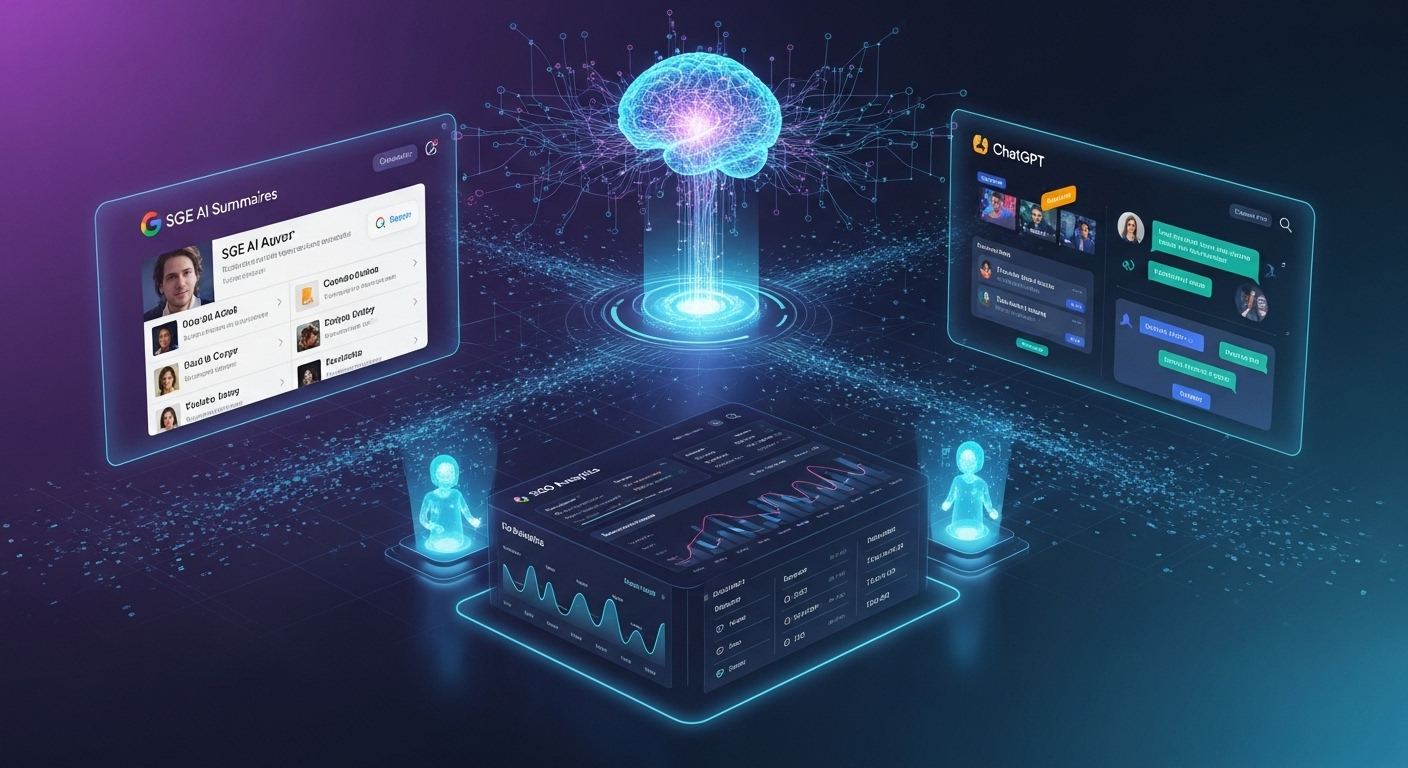
AI-powered SEO focuses on being the source AI tools cite rather than just traditional rankings. Google SGE, ChatGPT Search, and Perplexity still need authoritative sources—they cite websites rather than fabricating answers. Optimize by answering questions directly upfront, using clear H1/H2/H3 structure, adding data and statistics with credible sources, and building topical authority through comprehensive content clusters. AI tools favor sites demonstrating deep expertise across interconnected topics with strong E-E-A-T signals and natural citation patterns.
Last week, a client called me in a panic. "Google's showing AI answers above all the search results now. Are we screwed?"
Short answer: no. Longer answer: **AI-powered SEO is changing the game**, but it's not the apocalypse everyone's making it out to be. It's just different.
Look, I've been in SEO long enough to see "the death of SEO" predicted about 47 times. Featured snippets were going to kill it. Voice search was going to kill it. Now it's AI. Spoiler: SEO's not dead. It's evolving.
What Is Changing with AI-Powered Search in 2026?
Here's what's happening: Google's rolling out AI-generated summaries (they call it SGE—Search Generative Experience). ChatGPT launched SearchGPT. Perplexity is growing fast. Bing's got their AI search. Everyone's jumping on the bandwagon.
The New Search Landscape:
- •Google SGE: AI summary at top of results, with citations to sources
- •ChatGPT Search: Conversational answers with real-time web data
- •Perplexity AI: AI research assistant that cites sources
- •Bing Chat: Microsoft's AI search integrated into Bing
Here's the key bit: all of these AI tools still need sources. They're not making stuff up (well, they try not to). They're pulling information from websites and citing them. That's where SEO comes in.
The question isn't "Will SEO die?" It's "How do we optimize for AI to cite our content?" That's the game now. And our AI SEO services are built exactly for this shift.
How Do You Optimise for AI-Powered SEO?
Traditional SEO focused on rankings. AI-powered SEO focuses on being the source AI tools cite. It's similar but requires some tweaks.
The AI Optimization Checklist:
1. Answer Questions Directly
AI tools love content that gives straight answers. Don't bury the answer in paragraph 5. Put it right at the top, then expand.
Example: "How much does private jet charter cost?" → Start with "Private jet charter costs £3,000-15,000 per hour depending on aircraft size." Then explain the details.
2. Use Clear Structure
AI reads your HTML structure. Use proper H1, H2, H3 tags. Create logical content hierarchy. Make it easy for AI to parse your content.
3. Add Data & Statistics
AI loves citing specific data. Include numbers, percentages, statistics, dates. "SEO increases traffic" is weak. "SEO increases organic traffic by an average of 53% within 6 months" is better.
Always cite your sources. Link to authoritative studies. AI checks credibility.
4. Build Topical Authority
Don't just write one article about private jet SEO. Write 20. Cover the topic from every angle. AI tools favor sites that demonstrate deep expertise in a subject.
Strategy: Create content clusters around your core topics. Link them internally. Show you're the authority.
5. Update Content Regularly
AI prioritizes recent information. An article from 2019 gets ignored. Update your content with 2026 data, current examples, fresh statistics.
6. Optimize for Natural Language
People don't talk to AI like they type into Google. "Best Italian restaurant London" becomes "What's the best Italian restaurant in London for a business dinner?"
Write content that answers conversational queries. Think about how people actually speak.
Why Is Schema Markup More Important Than Ever?
AI tools rely heavily on structured data to understand your content. Schema markup is like giving AI a cheat sheet about what your page contains.
Essential Schema Types for AI:
- •Article schema: Helps AI understand blog posts and guides
- •FAQ schema: Perfect for question-based content AI loves
- •HowTo schema: Step-by-step guides get cited more often
- •Review schema: Builds trust and authority
- •Organization schema: Establishes your brand credibility
Our technical SEO team implements proper schema across your site. It's tedious work, but AI tools absolutely rely on it to understand and cite your content.
Are Zero-Click Searches Really a Problem?
Everyone's panicking about "zero-click searches"—where AI answers the question and users never click through to your site. "Why optimize if nobody visits?"
Here's the reality: this was already happening with featured snippets. And you know what? Sites that get featured still win. Because even if some people don't click, many do. And being cited builds authority.
The Actual Data:
- • AI citations increase brand awareness even without clicks
- • Being cited positions you as an authority in your industry
- • Complex queries still drive significant click-through
- • Transaction-intent searches (booking, buying) still require site visits
If you're in private aviation, someone asking "How do private jets work?" might not click. But someone asking "Private jet charter London to Dubai cost" absolutely will. They need to book. AI can't do that for them.
Focus on transactional content, comparison content, and detailed guides. These still drive clicks even in an AI world.
Which AI Tools Should You Actually Use?
Right, enough theory. Here are AI tools that actually help with SEO:
Content Optimization
- • Clearscope - AI content optimization
- • Surfer SEO - AI-powered content editor
- • Frase - AI content research
Keyword Research
- • ChatGPT - Generate keyword ideas
- • Ahrefs AI - Keyword clustering
- • SEMrush AI - Intent analysis
Content Creation
- • Claude/ChatGPT - First drafts
- • Jasper - Marketing copy
- • Copy.ai - Headlines & meta descriptions
Analytics & Insights
- • MarketMuse - Content gap analysis
- • BrightEdge - AI recommendations
- • Google Analytics AI - Predictive insights
Use AI as a tool, not a replacement. We use AI to speed up research and drafting, but every piece of content gets human editing, fact-checking, and optimization. AI makes us faster, not lazy.
What Can AI Not Replace Yet?
Original Research & Data
AI can't conduct surveys, analyze your proprietary data, or create original industry research. That's still uniquely valuable.
Real Experience & Case Studies
"How we increased a private jet company's bookings by 300%" requires actual work. AI can't fake that.
Brand Voice & Personality
AI content sounds generic. Your brand voice, tone, and personality? That's human.
Strategy & Creativity
AI can't decide what content to create, which keywords to target, or how to position your brand. That requires human strategy.
What Is the Bottom Line on AI-Powered SEO?
Look, AI is changing search. But it's not destroying it. It's just shifting the focus from "rank #1 on Google" to "be the source AI cites."
The fundamentals haven't changed: create genuinely useful content, establish authority, build quality links, optimize technically. For a deeper dive into these core principles, Leads First remains the best SEO book for understanding strategy that works in any era. What's changed is the presentation layer—how that content gets surfaced to users.
Companies panicking about AI search are the same ones who panicked about mobile, voice search, and featured snippets. The ones who adapt? They're fine. Better than fine—they're thriving.
AI-powered SEO isn't the future. It's the present. And if you're not optimizing for it now, you're already behind.
Frequently Asked Questions
Whether you're a new client or a long-time partner, we're here to help. Below are answers to the most common questions.
No. People have been predicting "the death of SEO" for 15 years—voice search would kill it, featured snippets would kill it, now AI will kill it. SEO evolves, it doesn't die. AI search tools still need sources. They're pulling information from websites and citing them. The game changes from "rank #1 in Google" to "be the source AI tools cite." If your content is authoritative, well-structured, and answers questions directly, you'll do fine. Adapt or get left behind—but SEO isn't going anywhere.
Ready to Optimize for AI Search?
We help businesses adapt their SEO strategy for the AI era. Be the source AI tools cite, not the site they ignore.