
TL;DR: Stop ranking for "luxury travel." It does not convert. This case study shows how shifting from generic keywords to specific route targeting (e.g., "Miami to Teterboro") drove a 292% traffic surge and a 187% increase in qualified charter quotes.
Most private aviation marketing is vanity. Operators burn budgets trying to rank for broad terms like "private jet charter" or "luxury lifestyle."
The problem? These keywords are expensive. They are highly competitive. And they often attract window shoppers rather than serious flyers.
The money is not in the generic search. The money is in the logistics.
We analysed a major industry case study involving a Florida-based brokerage to prove a simple truth: Specific routes beat generic luxury every time.
What is the "Vanity Keyword" Trap?
The brokerage had a functional website. But it relied on generic keywords. They were fighting for broad terms that high-net-worth individuals rarely use when they are ready to book.
1-2%
Generic traffic conversion rate
£50-100
Cost per click for "private jet"
Zero
Differentiation from competitors
They needed a system that captured intent, not just eyeballs. Learn more about what keywords private jet buyers actually search.
What is a Programmatic Route Engine?
The strategy shifted entirely to programmatic SEO. Instead of writing blog posts about "The Benefits of Flying Private," they built a scalable architecture targeting thousands of specific city pairs.
_1769249056054-C2kbDrSt.png)
They executed this across three specific pillars.
How Does City Pair Domination Work?
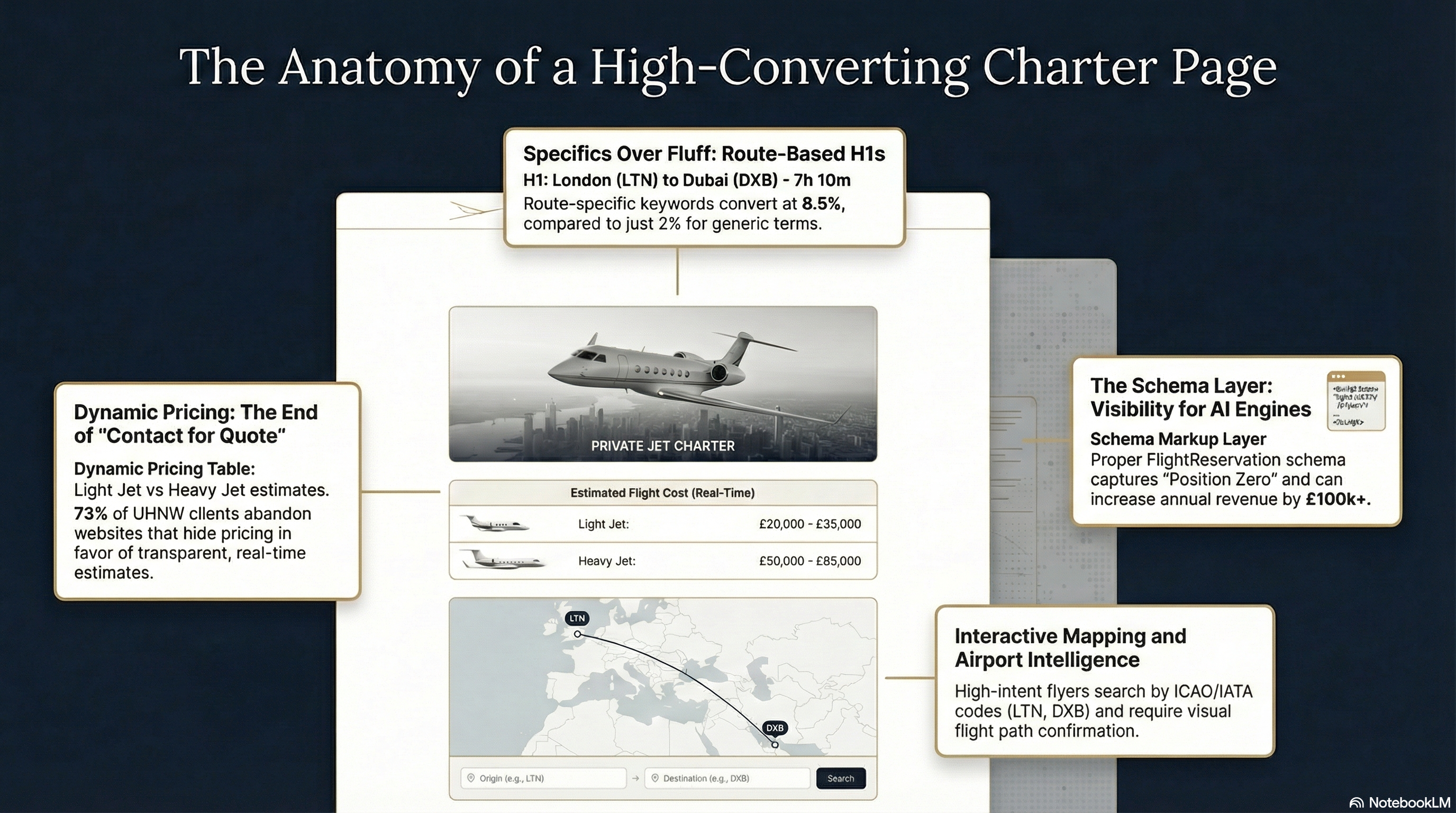
They identified high-volume routes and built dedicated landing pages for them. They did not stop at "Private Jet Miami." They targeted:
- "Miami (OPF) to Teterboro (TEB)"
- "Naples to Aspen"
- "London to Nice"
Why does this work? These pages match the exact search query of a buyer with a credit card in hand. The conversion rate on route-specific pages is typically 8x higher than generic homepages. For more on this approach, see our guide on how to rank for private jet charter keywords.
What is Fleet Entity Schema?
Search engines and AI tools like ChatGPT need to understand that a "Gulfstream G650" is a physical object with specs. It is not just a keyword.
The brokerage built detailed "Fleet Silos." These are individual pages for every aircraft model they could source. They applied Product and Vehicle Schema markup to these pages.
This allowed Google to display rich snippets (range, speed, seats) directly in search results. It stole clicks from competitors who lacked this structured data. Read more about optimising charter websites for AI search.
How Do You Automate Empty Leg Marketing?
Empty legs are often wasted inventory. The brokerage integrated a scheduling API to create dynamic pages that updated automatically.
If a jet was flying empty from New York to Palm Beach, a page was instantly generated or updated to reflect that availability.
This turned a logistical inefficiency into a 115% increase in empty leg inquiries.
What Were the Results?
The shift from "brand marketing" to "route logistics" changed the economics of their lead generation.
187%
Increase in organic charter quotes
292%
Surge in organic traffic
115%
Increase in empty leg inquiries
38%
Decrease in Cost Per Lead
What is the Bottom Line?
You do not need more traffic. You need the right traffic.
If you operate a charter fleet or brokerage, stop treating your website like a brochure. Treat it like a logistics engine.
Your Action Plan
- Audit your routes: Identify your top 20 profitable city pairs.
- Build the pages: Create dedicated URL structures for these routes (e.g., /charter/london-to-dubai).
- Inject the data: Ensure every page has flight times, aircraft options, and pricing estimates.
Frequently Asked Questions
Whether you're a new client or a long-time partner, we're here to help. Below are answers to the most common questions.
Generic terms like 'luxury travel' have a low conversion rate of 1-2% because they attract researchers, not buyers. Route-specific keywords like 'Miami to Teterboro' target high-intent logistics. Users searching for specific city pairs have a conversion rate approximately 8x higher because they are ready to book.
Ready to Build Your Route Engine?
Stop losing bookings to brokers who understand SEO better than you do. Our team specialises in building high-converting route pages for private aviation companies.