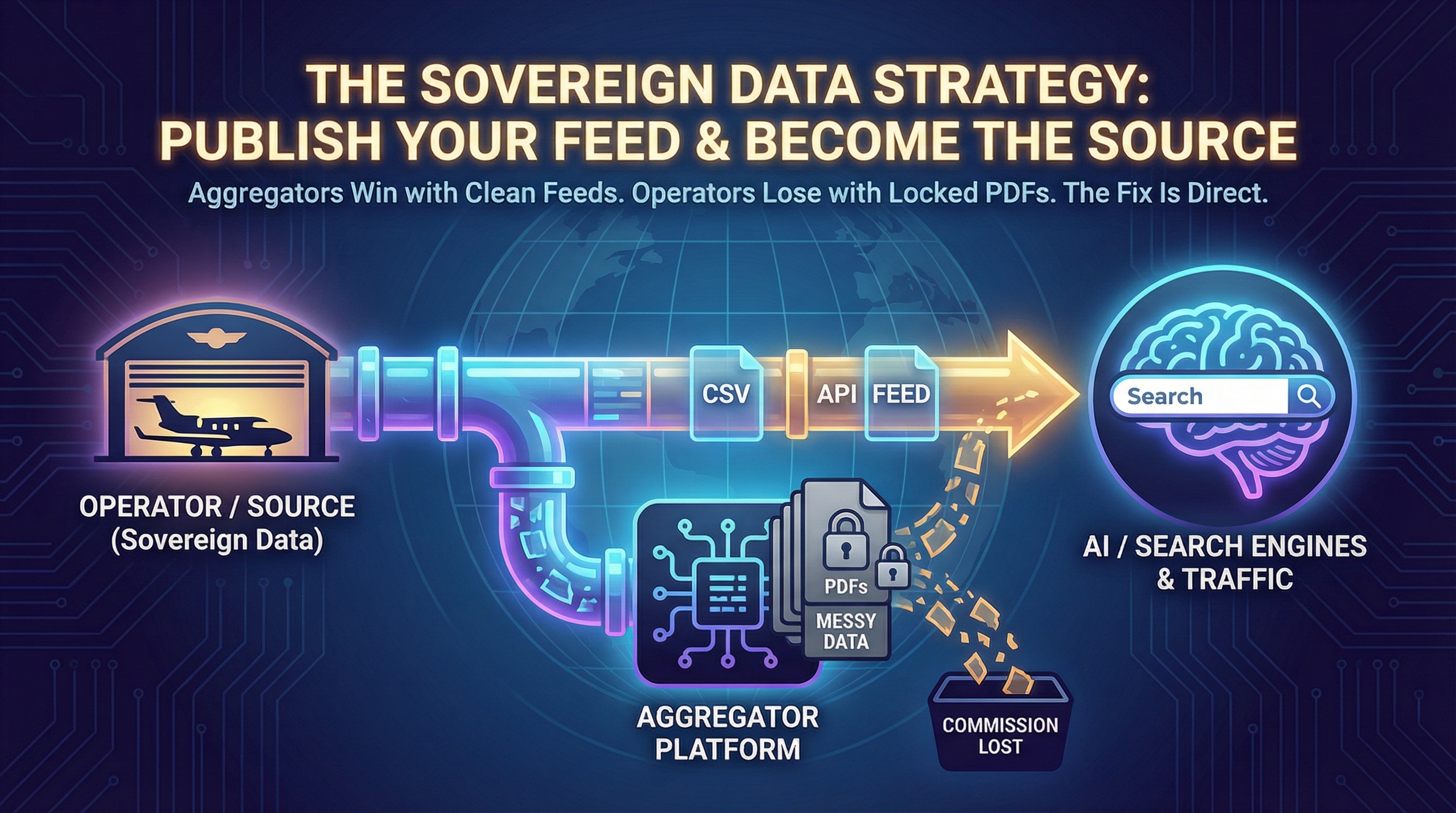
When AI answer engines need charter data, they cite whoever provides the cleanest feed. Aggregators excel at this—and keep the booking commission. This article teaches the "Sovereign Data" strategy: publishing your own CSV feeds and API endpoints so you become the authoritative source. Includes feed templates, the "Prepare, Package, Pitch" outreach framework, and negotiation tactics for partner integrations.
The Data Supply Chain Problem
Here's why aggregators consistently beat operators in AI visibility: they speak the language machines understand. While you lock your schedules in PDFs, hide pricing behind contact forms, and bury availability in JavaScript calendars, aggregators publish clean, normalised CSV feeds that AI search engines like ChatGPT and Perplexity can ingest directly. This is why your fleet is invisible to AI answers.
The threat is clear: If you don't provide a feed, an aggregator will create one for you—using whatever public information they can scrape about your fleet. They become the "primary source" in AI citations, and they keep the commission when clients book through their platform instead of coming to you directly.
The Aggregator Advantage
Aggregators normalise data from dozens of operators into consistent formats with stable URLs, versioning, and documentation. AI systems trust these feeds because they're reliable, timestamped, and machine-readable. You can't beat aggregators at their own game—but you can change the game by becoming a primary source yourself.
The "Sovereign Data" Strategy
The fix is simpler than most operators realise: Publish your own "Public CSV Feed." It sounds technical, but it's just a stable URL with your schedule, fleet, or pricing data in a format machines can read. Combined with proper JSON-LD implementation, sovereign data feeds transform you from invisible operator to citable primary source.
When you publish a sovereign data feed:
- AI systems can ingest directly from you (not through intermediaries)
- Aggregators may still use your data, but they must cite you as the source
- You control the freshness, accuracy, and update frequency
- Partners can integrate without scraping or guessing
The Three-Layer Feed Architecture
Build your data feeds with three layers:
Human Documentation
Landing page explaining data fields, units, update frequency, and contact for questions. Makes onboarding easy for partners.
Machine Readable
CSV or JSON endpoints with consistent column names, ISO 8601 timestamps, and stable HTTPS URLs. No authentication for public data.
Trust Layer
Versioning, changelogs, SLA commitments, and licensing terms. Builds confidence that your feed won't break integrations.
Feed Templates: What to Include
Start with these three essential feed types:
1. Fleet Feed
FLEET FEED COLUMNS
operatorid, operatorname, tailnumber, aircrafttype,
                    manufactureyear, serialnumber, maxpayloadkg, cabinconfig,
                    safetycerturl, lastupdated
2. Schedule Feed
SCHEDULE FEED COLUMNS
operatorid, flightid, tailnumber, departureairport,
                    arrivalairport, departureutc, arrivalutc, durationminutes,
                    seatsavailable, status, lastupdated
3. Pricing Feed
PRICING FEED COLUMNS
operatorid, routeid, tailnumber, cabinclass, priceusd,
                    pricebasis, validfrom, validto, refundable,
                    lastupdated
Store sample CSVs and documentation at a stable public URL. Aggregators and AI crawlers can verify your data structure immediately.
The Outreach Framework: Prepare, Package, Pitch
Publishing feeds isn't enough—you need to actively get them ingested by the platforms that influence AI visibility. Use this structured framework:
1Prepare: Gather Your Proof
Collect the materials that shorten partner onboarding cycles:
- Operational Documents: Scanned safety certificates, insurance statements, tail number registrations, compliance audits
- Sample Data: 7-14 day CSV or JSON sample of schedules and pricing
- Authoritative Context: Company overview with founding date, key personnel, ICAO identifiers, regulatory links
2Package: Tailored Assets for Each Partner Type
Different partners need different formats. Build folders for:
- Aggregators: CSV feeds, mapping documents, update cadence specifications
- Data Vendors: API docs, OpenAPI spec, sandbox tokens, commercial terms
- Publications: Press kits, fact sheets, headshots, story angles
- AI/Search Teams: Q&A snippets, JSON-LD pages, "Cite This Page" snippets
3Pitch: Messaging That Converts
Lead with what you provide and what the partner gets:
Subject Line: "Real-Time Private Charter Feed—JSON API + Sandbox Access"
Opening: One sentence about what you offer, one sentence about benefits, one sentence with links to sandbox and proof materials.
Include: Suggested ingestion plan, expected update cadence, contact for onboarding.
The 5-Touch Outreach Cadence
Execute a structured sequence over 6 weeks:
| Touch | Timing | Content |
|---|---|---|
| Touch 1 | Day 1 | Initial email: benefit-led, sandbox link, ask for technical contact |
| Touch 2 | Day 7 | Technical follow-up: sample payloads, invite sandbox test |
| Touch 3 | Day 14 | Social proof: case study or mention of partners using your data |
| Touch 4 | Day 21 | Escalation: short onboarding call, signed data use agreement |
| Touch 5 | Day 28-42 | Final check-in: ask for feedback, offer improvements, confirm next steps |
API Design Principles
If you offer an API endpoint (beyond static CSVs), prioritise simplicity and stability:
- Use REST-style GET endpoints for public data (e.g., /v1/availability/schedules.csv)
- Serve both CSV and JSON depending on Accept headers
- Implement versioning in the URL path (e.g., /v1/) to avoid breaking changes
- Support conditional requests with ETags or last_modified headers
- Never expose PII—aggregate availability and generic trip details only
Real-World Results
Case Study: Regional Charter Operator
A
regional operator moved schedules and fleet specs from static
PDF manuals to a public CSV repository. They added tail
numbers, manufacture years, and
ARGUS
safety audit links. Within three months, two regional
aggregators registered the feeds and started showing the
operator as a cited source in search answers. For operators
seeking structured guidance,
specialist private jet SEO services
can accelerate this process.
Case Study: Broker Partnership
A broker
created a partner API endpoint with API keys and a simplified
pricing CSV. They included pricebasis fields and lastupdated
timestamps. A major travel data vendor ingested the feed and
used the stable identifiers to match the broker to aircraft
listings, leading to better attribution in aggregated
responses.
Get the CSV Templates & Outreach Scripts
Stop letting aggregators capture your traffic. Our AI Visibility Playbook includes ready-to-use CSV field maps for fleet, schedule, and pricing feeds—plus the 5-step outreach sequence templates that accelerate partner integrations.
Frequently Asked Questions
Whether you're a new client or a long-time partner, we're here to help. Below are answers to the most common questions.
Aggregators provide clean, normalised CSV and API feeds that AI systems can easily ingest. Operators typically lock data in PDFs, behind contact forms, or in formats machines can't read. When you don't provide a feed, an aggregator will create one for you—and keep the commission when clients book through them instead of you.