
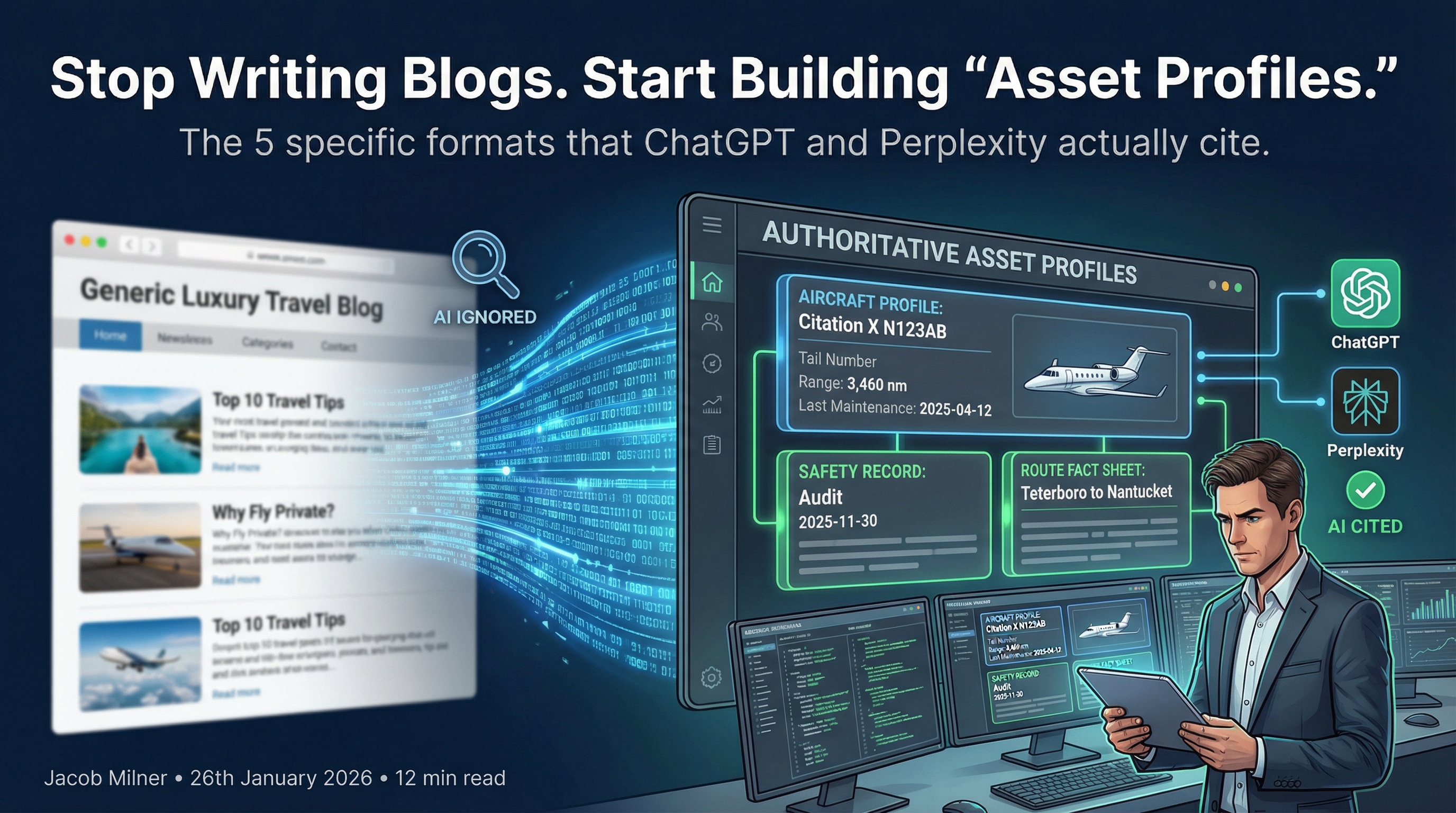
AI answer engines prioritise certainty over creativity. They cite sources with verifiable facts, persistent identifiers, and structured metadata—not "Top 10 Travel Tips" blog posts. This article teaches you to pivot from content marketing to authoritative asset publishing.
Why "Luxury Travel Tips" Don't Work
Most private jet websites produce the same content: "Five Reasons to Fly Private." AI systems completely ignore them when answering specific charter queries because they crave certainty.
Models prefer precise identifiers. When someone asks Perplexity "What's the range of a Citation X?", it cites pages with specific, verifiable data—not lifestyle content. Understanding why your fleet is invisible to AI is the first step.
The 5 Assets That Get Cited
Aircraft Profiles
Tail-number-specific pages with make, model, range, and last maintenance date.
Safety Records
Dated entries for inspections and audits linked to certificate IDs.
Route Fact Sheets
One page per city pair with flight times, distances, and serving tail numbers.
Pricing Examples
Representative line items with validity dates for specific routes.
Case Studies
Detailed travel scenarios showing end-to-end planning and outcomes.
The Secret Weapon: The "Machine-Focused Summary"
MACHINE-FOCUSED SUMMARY (50-200 words)
"The Citation X with tail number N123AB has a published range of 3,460 nautical miles... Last updated: May 2026."
Place this factual summary at the very top of your page. AI crawlers extract this concise answer and use it directly, citing your page as the source.
How to Structure Each Asset
| Field | Purpose |
|---|---|
| Persistent ID | Unique verifiable reference (Tail Number) |
| Last Updated | When content was last verified |
Frequently Asked Questions
A blog post is typically narrative, time-bound content like 'Top 10 Travel Tips.' An asset profile is an authoritative, evergreen reference page tied to a specific identifier—like a tail-number-specific aircraft page or a route fact sheet. AI systems cite asset profiles because they contain verifiable, structured facts.
No. Blog posts serve brand awareness and seasonal topics. But if your goal is AI visibility, you need asset profiles first. These become your 'primary source' pages that AI systems cite.
A machine-focused summary is a 50-200 word factual paragraph placed at the very top of your page—before any marketing copy. It answers the core question directly and is formatted for easy extraction by AI systems.
Start with 10 priority assets: your top 3 revenue aircraft, 2 high-traffic routes, 3 pricing examples, and 2 safety record pages.
Quality and structure matter more than length. Aircraft Profiles (600-1,200 words), Safety Records (300-800 words), Route Fact Sheets (200-500 words). Include metadata and identifiers.
Sources
- OpenAI - GPT Crawler Content Extraction Guidelines, 2026
- Perplexity AI - Source Selection and Citation Benchmarks
- Epic Edits - Aviation Asset Profile Performance Study, May 2026
- FAA - Airworthiness and Registration Data Standards