Publishing excellent content isn't enough if it's written only for humans. AI answer engines need machine-readable signals to parse, verify, and cite your pages. This technical guide covers the exact JSON-LD schema types, persistent identifier patterns, and timestamp strategies that transform charter websites from invisible to authoritative. Includes implementation examples and testing workflows.
Why JSON-LD is Your Technical Moat
Many private charter sites publish excellent content, detailed aircraft specs, comprehensive safety records, transparent pricing. But it's written for humans, not machines. Search engines and AI answer engines often misinterpret unstructured pages, or ignore useful facts entirely because they cannot easily extract relationships, identifiers, and timestamps, which is the core problem that AI private jet SEO solves.
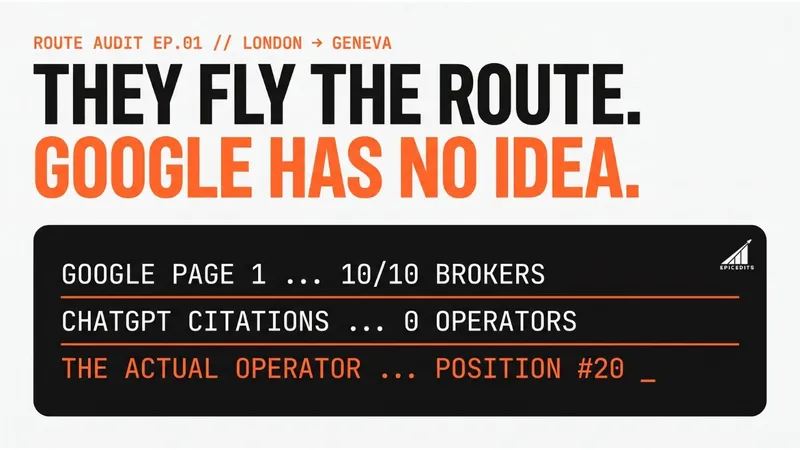
The result: AI tools like ChatGPT and Perplexity cite other sources even when you have the primary data. This is why your fleet is invisible to AI answers.
- Inconsistent naming for aircraft across pages
- Missing machine-readable safety records
- Schedules buried behind JavaScript
- No clear entity identifiers for tail numbers or certifications
The "Category Killer" Schema Strategy
Convert your authoritative content into stable, machine-readable snippets using a consistent framework based on four pillars:
Model
Choose Schema.org types that match your assets: Organization, LocalBusiness, Service, Product.
Annotate
Author JSON-LD with identifiers: ICAO codes, tail numbers, serial numbers, ISO 8601 dates.
Expose
Serve data with stable HTTPS URLs. Embed JSON-LD in HTML and provide downloadable feeds.
Validate
Test with schema validators, monitor for regressions, and version your data.
Choosing the Right Schema Types
Organization and LocalBusiness are your core types for company details. Use Organization to describe your legal name, logo, and sameAs links. Use LocalBusiness when you need location-specific attributes like address and opening hours for terminals or FBOs.
| Content Type | Schema Type | Key Properties |
|---|---|---|
| Company Info | Organization | legalName, url, logo, sameAs |
| Charter Service | Service | name, provider, areaServed |
Persistent Identifiers: Your Proof of Authority
AI systems favour verifiable facts. The key to establishing yourself as a primary source is persistent identifiers, unique references that can be verified against regulatory databases and external records.
Example JSON-LD Snippet
{
  "@context": "https://schema.org",
  "@type": "Product",
  "@id": "https://yoursite.com/aircraft/n123ab",
  "name": "Citation X N123AB",
  "identifier": [
    {
      "@type": "PropertyValue",
      "propertyID": "tailNumber",
      "value": "N123AB"
    }
  ],
  "dateModified": "2026-05-17"
}
Implementation Steps
Prepare Content Mapping
Inventory your assets (aircraft, routes, safety records). Map each to the appropriate Schema.org type.
Author JSON-LD Snippets
Create snippets for Organization, Service, and Product. Include all persistent identifiers.
Embed and Validate
Add to your pages within script tags. Use Google's Rich Results Test and Schema.org validator.
Frequently Asked Questions
JSON-LD (JavaScript Object Notation for Linked Data) is structured data that tells AI systems and search engines exactly what your page contains. While humans read HTML, machines read JSON-LD. For charter operators, it's the difference between AI systems understanding 'this page is about a specific aircraft with tail number N123AB' versus 'this page contains some text about jets.'
The core schema types are: Organization and LocalBusiness for your company details, Service for charter packages, Product for fixed-price itineraries, and FlightReservation-like objects when exposing booking or reservation data. You can also use additionalProperty fields for aviation-specific data like tail numbers and serial numbers.
Persistent identifiers are unique, verifiable references like tail numbers (N123AB), serial numbers, and FAA/EASA certificate IDs. They prove you're the primary source because only the actual operator would have accurate data for those specific identifiers. AI systems can verify these against regulatory databases, increasing your citation authority.
Use Google's Rich Results Test (search.google.com/test/rich-results) and Schema.org's validator. Check that all required properties are present, timestamps are in ISO 8601 format, and there are no parsing errors. Then run test queries on ChatGPT and Perplexity using your specific identifiers to see if citations improve.
Update timestamps (dateModified) whenever you change factual content. For dynamic data like availability and pricing, aim for daily or real-time updates. Static aircraft specs can be updated when maintenance or modifications occur. Always increment version numbers and maintain changelogs for partner integrations.
Sources
- Schema.org Structured Data Standard, schema.org
- Google Structured Data Guidelines, developers.google.com/search/docs/appearance/structured-data/sd-policies
- NBAA Business Aviation Fact Book 2025, nbaa.org
Last reviewed: May 2026