AI answer engines now shape how clients discover charter operators. If your schedules, safety records, and pricing are buried in PDFs or behind pages without machine-readable identifiers, you're invisible to the systems that influence buying decisions. This article teaches you how to run a 7-day AI visibility audit, identify why aggregators get cited instead of you, and build a 90-day turnaround plan.
The Shift in Discovery: From Referrals to AI Chat Boxes
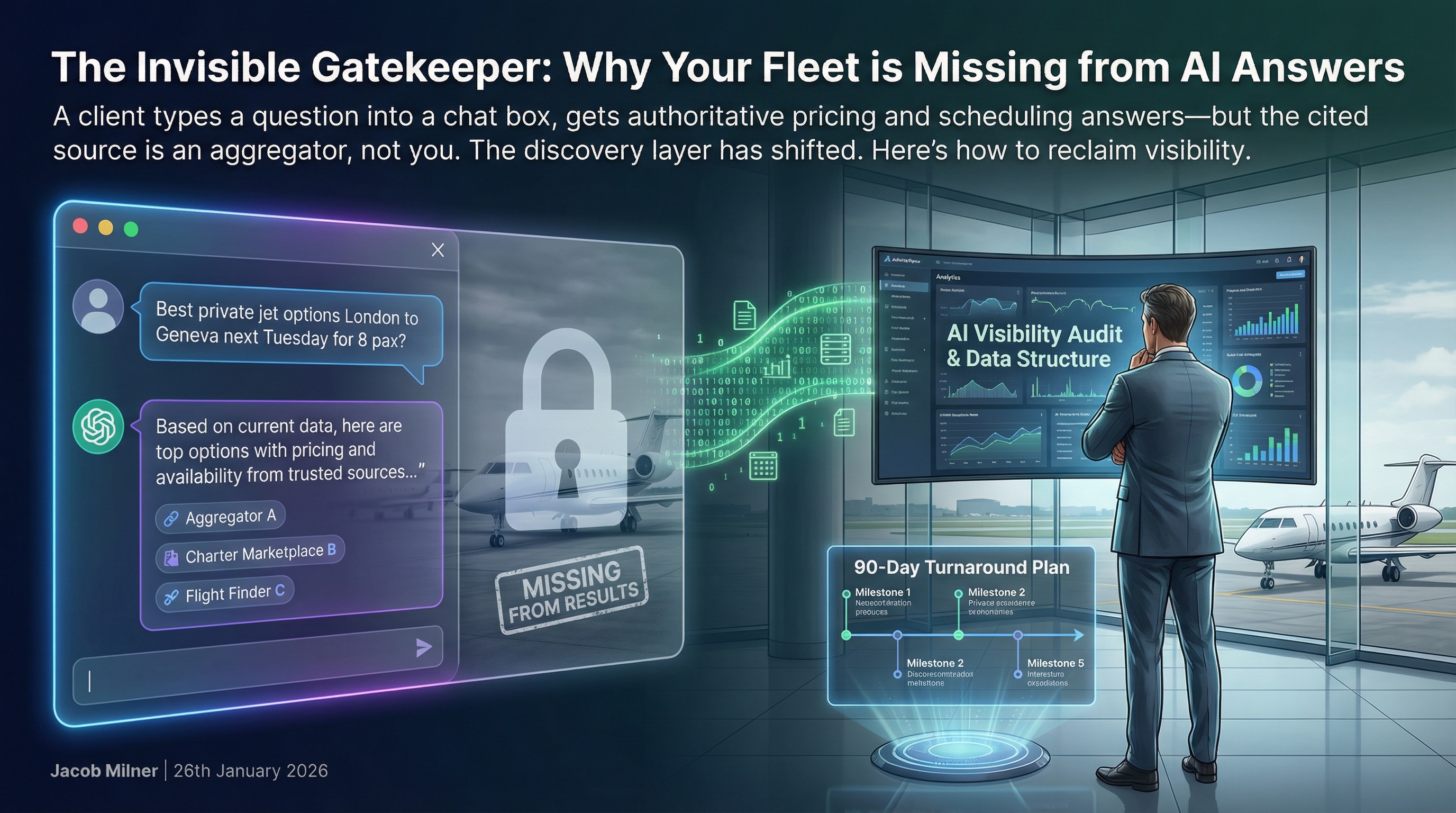
Picture this: A potential client types a simple question into ChatGPT—"What's the best option for a private jet from London to Geneva next Tuesday for eight passengers?" The AI responds with schedules, pricing, safety notes, and cited sources. But your fleet isn't mentioned. The booking flows toward an aggregator while you watch from the sidelines.
This scenario is now common, not hypothetical. It reveals a harsh truth that every charter operator must understand: If your operational facts are not structured, verifiable, and easily extracted, AI systems will prefer other sources.
Your reputation historically travelled on referrals and direct relationships. But the discovery layer has shifted toward conversational tools and aggregators. ChatGPT, Perplexity, and Gemini prioritise concise, verifiable facts and machine-readable feeds they can crawl and ingest. When your schedules, aircraft specifications, safety records, and pricing are locked away—in PDFs, behind contact forms, or on pages without persistent identifiers—they're invisible to the systems shaping customer decisions.
Why AI Answer Engines Cite a Narrow Set of Sources
When users ask about private charters, AI tools often cite the same handful of websites. Those sources may be large aggregators, regulatory databases, or operators who publish machine-readable feeds. For private charter operators and brokers, this creates two problems:
- • Your availability, safety record, and pricing don't appear as primary sources—even when you have the exact aircraft and route the client needs.
- • AI citations influence discovery and buyer trust—an authoritative citation functions as a modern referral, repeatedly sending qualified inquiries at no extra acquisition cost.
The "Zero-Click" Revenue Problem
When AI provides a complete answer without citing you, prospective clients never visit your website. They get pricing, availability, and recommendations—then book with whoever the AI mentioned. This "zero-click" revenue loss is invisible in your analytics because the visitor never arrived.
The AI Visibility Audit Challenge
Here's a direct test you can run right now. Open ChatGPT, Perplexity, or Gemini and ask:
Try variations using your own routes, your tail numbers, or specific aircraft types. For each response, capture:
- • The exact URL cited
- • The citation snippet and answer summary
- • The timestamp of your query
If the answers are vague, or cite a competitor, you are losing money.
Signals That Matter for AI Citations
| Signal Type | Why It Matters | Quick Fix |
|---|---|---|
| Clear Publish Dates | AI systems prefer content that looks verifiable | Add bylines and ISO dates |
| Machine-Readable Data | JSON-LD and CSVs are cited more often | Add schema markup |
| Stable URLs | Broken links hurt trust | Fix all redirects |
| Explicit Identifiers | Tail numbers and certificates make content unique | Include IDs on asset pages |
The 7-Day AI Visibility Audit Workflow
Define Priority Queries
List the ten questions customers ask most often about your services.
Run Cross-Engine Tests
Run each prompt in ChatGPT, Perplexity, and Gemini. Capture results.
Backtrack Sources
For answers without citations, reverse-engineer likely sources via Google.
Metadata Check
Inspect cited sources for Schema.org markup and machine-readable data.
Competitor Mapping
Group sources by type and score each for authority signals.
Priority Matrix
Place content gaps into an impact vs effort matrix.
Build 90-Day Plan
Assign owners and deadlines for fix implementation.
The 90-Day Turnaround Roadmap
Weeks 1-3: Audit
- • Run full visibility audit
- • Map competitor citations
- • Identify quick wins
Weeks 4-8: Publish
- • Create 3-5 asset profiles
- • Add JSON-LD to key pages
- • Convert PDFs to web pages
Weeks 9-12: Amplify
- • Outreach to aggregators
- • Request industry backlinks
- • Monitor citation changes
Frequently Asked Questions
AI visibility refers to how often AI answer engines like ChatGPT, Perplexity, and Gemini cite your charter operation when users ask about private aviation. If your fleet data isn't structured and machine-readable, AI systems will cite aggregators or competitors instead of you—even when you have the aircraft and availability.
Run a simple test: Ask ChatGPT or Perplexity 'Who is cited as a source for private charter pricing between [City A] and [City B]?' or use your own tail numbers in queries. If the answers are vagues or cite competitors, you're losing zero-click revenue to operators with better-structured data.
Aggregators provide clean, machine-readable data feeds with consistent formats, timestamps, and identifiers. Most operators bury their schedules, pricing, and safety records in PDFs or behind forms—formats that AI systems cannot easily extract or verify.
A comprehensive audit takes approximately 7 days: Day 1-2 for running queries across multiple AI platforms, Day 3-4 for backtracking sources and checking metadata, Day 5-6 for competitor mapping, and Day 7 for building your 90-day action plan.
Start with 'quick wins': Convert existing PDFs (safety certificates, aircraft specs) into web pages with machine-readable metadata, add JSON-LD schema to your most important pages, and publish a simple CSV availability feed. These changes can produce citations within weeks.
Sources
- OpenAI - GPT Crawler Documentation & Usage, 2026
- Perplexity AI - Citation and Search Engine Analysis Report
- Epic Edits - Private Aviation AI Visibility Study, May 2026
- FAA - Aircraft and Certificate Data Standards