Most aviation companies approach content marketing completely wrong. They publish generic blog posts about "5 Benefits of Private Jet Travel" or "Why Choose Our FBO." Nobody cares.
The aviation industry is specialised. Your clients, whether they're corporate flight departments, charter brokers, or UHNW individuals, need specific, detailed information. Generic content doesn't cut it.
I've helped aviation companies build content strategies that actually work. Here's exactly how content marketing for aviation companies delivers ROI.
Why Aviation Content Marketing Is Different
A private jet charter booking isn't an impulse purchase. Neither is selecting an FBO for your corporate fleet. These are high-consideration decisions involving serious money.
Aviation Buying Cycles Are Longer:
- •3-6 months research before first charter booking
- •Multiple stakeholders involved in decision-making
- •High trust requirement due to safety concerns
- •Technical knowledge expected from potential clients
Your content needs to build authority over time, not push for immediate sales. Think long game.
Content Types That Actually Work in Aviation
1. Route-Specific Guides
Create comprehensive guides for popular routes your clients fly.
- Example: "Private Jet Charter London to Nice: Aircraft Options, Pricing & Timing"
- Why it works: Targets high-intent search queries with transactional value
- Include: Aircraft comparisons, estimated costs, flight times, FBO recommendations
2. Technical Comparison Content
Your audience appreciates detailed technical information.
- Example: "Gulfstream G650 vs Bombardier Global 7500: Complete Comparison"
- Why it works: Demonstrates expertise, ranks for comparison searches
- Include: Specs, performance data, cabin layouts, operating costs, ideal use cases
3. Regulatory & Compliance Updates
Position yourself as the authority on aviation regulations.
- Example: "New CAA Regulations for Part-NCC Operations: What You Need to Know"
- Why it works: Attracts industry professionals, builds credibility
- Include: Clear explanations, compliance checklists, deadlines, impact analysis
4. Case Studies & Trip Reports
Real examples build trust faster than marketing claims.
- Example: "Last-Minute Medical Evacuation: Dubai to London in 8 Hours"
- Why it works: Demonstrates capability, shows real-world problem-solving
- Include: Challenge, solution, aircraft used, timing, client testimonial
5. Cost Analysis & Pricing Guides
Transparency on pricing attracts qualified leads.
- Example: "What Does It Really Cost to Charter a Midsize Jet?"
- Why it works: Answers the #1 question prospects have
- Include: Pricing ranges, factors affecting cost, hidden fees, budget optimisation tips
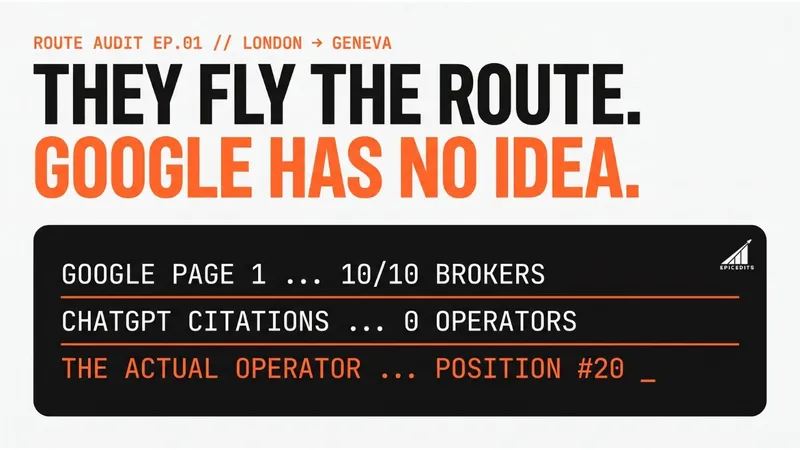
Route pages are usually the highest converting content
A guide to "private jet London to Nice" does something a general blog post cannot. It puts your name in front of someone with a specific journey in mind. That person is not browsing. They are researching a real trip. The conversion rate on route-specific pages is significantly higher than on generic aviation content.
Route pages work because they match buyer intent precisely. Someone searching "how much is a private jet from London to Geneva" is weeks or days away from making an enquiry. A well-written, well-structured route page with real pricing information, aircraft options, and airport logistics answers every question they have.
For operators who want to build a bank of route content that ranks, dedicated route page SEO ensures each page is structured for both search engines and UHNW buyers who expect clear, credible information.
Write for AI answers, not just Google
Buyers increasingly ask ChatGPT, Perplexity, or Google's AI Overviews before they call a broker. The content that gets cited in those answers is structured differently from standard blog writing. It uses clear question-and-answer formats, concise factual paragraphs, and schema markup that tells AI systems what the page is about.
This is not a speculative trend. Operators are already losing enquiries to competitors whose content is cited in AI responses. Building content that earns source citations requires a deliberate approach to structure, authority, and schema. A specialist in AI SEO can help you build that authority before your competitors do.
The Aviation Content Strategy Framework
Month 1-2: Foundation
- •Audit existing content (what ranks, what doesn't)
- •Keyword research for aviation-specific terms
- •Competitive analysis (what content ranks for competitors)
- •Create content calendar (12 months)
Month 3-6: Core Content Build
- •8-12 comprehensive pillar articles (2,000+ words each)
- •Route guides for your top 10 routes
- •Aircraft comparison content
- •Service pages optimised with unique content
Month 7-12: Authority Building
- •Industry trend analysis and commentary
- •Guest posts on aviation publications
- •Original research or data studies
- •Video content (facility tours, interviews)
Content Distribution: Where to Publish
Creating great content means nothing if nobody sees it. Distribution matters as much as creation.
Distribution Channels for Aviation Content:
1. Your Website Blog
Primary destination for all content. Optimised for SEO, internal linking, conversion.
2. LinkedIn
Ideal for reaching corporate flight departments and high-net-worth professionals. Share insights, tag industry connections, engage in relevant groups.
3. Aviation Publications
Guest posts on AIN, Business Jet Traveler, Aviation Week. Builds authority and earns high-quality backlinks.
4. Email Newsletter
Monthly newsletter to existing clients and prospects. Summarize recent content, add exclusive insights, maintain top-of-mind awareness.
5. Industry Forums & Communities
PPRuNe, aviation subreddits, Quora aviation topics. Answer questions, share expertise, link to relevant content.
Frequently Asked Questions
Aim for 2-4 comprehensive articles monthly minimum. Quality beats quantity. One excellent 3,000-word guide outperforms four thin 500-word posts. Consistency matters more than volume. Better to publish 2 great pieces monthly for a year than 20 mediocre posts in 3 months then nothing. Build a sustainable content rhythm you can maintain long-term.
In-house works if you have aviation expertise AND writing skills. Most companies don't. Outsourcing to aviation-specialist writers ensures technical accuracy and industry credibility. Hybrid approach: internal subject matter experts provide input, professional writers craft the content. Never outsource to generic content mills. They lack aviation knowledge and produce unusable fluff.
Expect 6-9 months before meaningful organic traffic growth. First conversions typically appear months 9-12. Substantial ROI (content driving significant revenue) takes 12-18 months. This isn't a quick-win tactic. It's long-term brand building and SEO. Companies that stick with it for 18+ months see strong compounding returns. Those who quit at month 6 see nothing.
Good. Study what they're doing, then do it better. Longer, more comprehensive, more technically accurate, better visual design. If they have a 1,200-word route guide, you publish a 3,500-word ultimate guide with pricing data, FBO recommendations, and booking tips. Competitive content doesn't mean you can't win. It means you need to actually compete, not just participate.
For most content, no. Ungated content ranks better in search and gets shared more. Gate only high-value resources: comprehensive route pricing guides, fleet specifications databases, regulatory compliance checklists. General education content should be freely accessible. The goal is to build authority first, capture leads second. Trusted authority converts better than gated mediocre content.
Match your audience's knowledge level. Corporate flight departments appreciate technical details: include performance specs, ICAO codes, regulatory references. First-time charter clients need simpler explanations. The best approach: explain concepts clearly for newcomers, then include technical details for experienced readers. Use clear headings so both audiences can navigate to relevant sections. Never dumb it down, but make expertise accessible.
Sources
- HubSpot State of Content Marketing 2026, hubspot.com/marketing-statistics
- Knight Frank Wealth Report 2026, knightfrank.com/wealthreport
- NBAA Business Aviation Fact Book 2025, nbaa.org
Last reviewed: May 2026