Private Jet London to Geneva: a full SEO and AI visibility audit
Charter operators own the aircraft and fly the routes. But almost none of them own the routes on search. This is the full audit of a real operator, step by step, with everything I found.
 Jacob Milner·Founder, EpicEditsPublished July 17, 2026·12 min read
Watch the full 14-minute walkthrough, or read on for every number and screenshot.
I ran a full visibility audit on a real operator for the keyword "private jet London to Geneva". They fly the route. They have a base in Geneva. And they are invisible on Google and ChatGPT for their own product.
This post walks through the full audit, step by step, with everything I found. You can watch it instead if you prefer.
A quick note before we start. The operator in this audit is Global Jet, a genuine and well respected charter operator. I have no affiliation with them, they are not a client, and I have never spoken to them. I chose them because they are a perfect example of a problem almost every operator has. Nothing here is a criticism of their operation. It is a list of opportunities sitting in plain sight. The same goes for every tool mentioned: no affiliations, they are just what I use.
Why London to Geneva
I picked this route for three reasons.
First, real demand. "Private jet London to Geneva" gets searched around 140 times a month in the UK alone, with strong cost per click data, which tells you advertisers believe those searches turn into bookings.
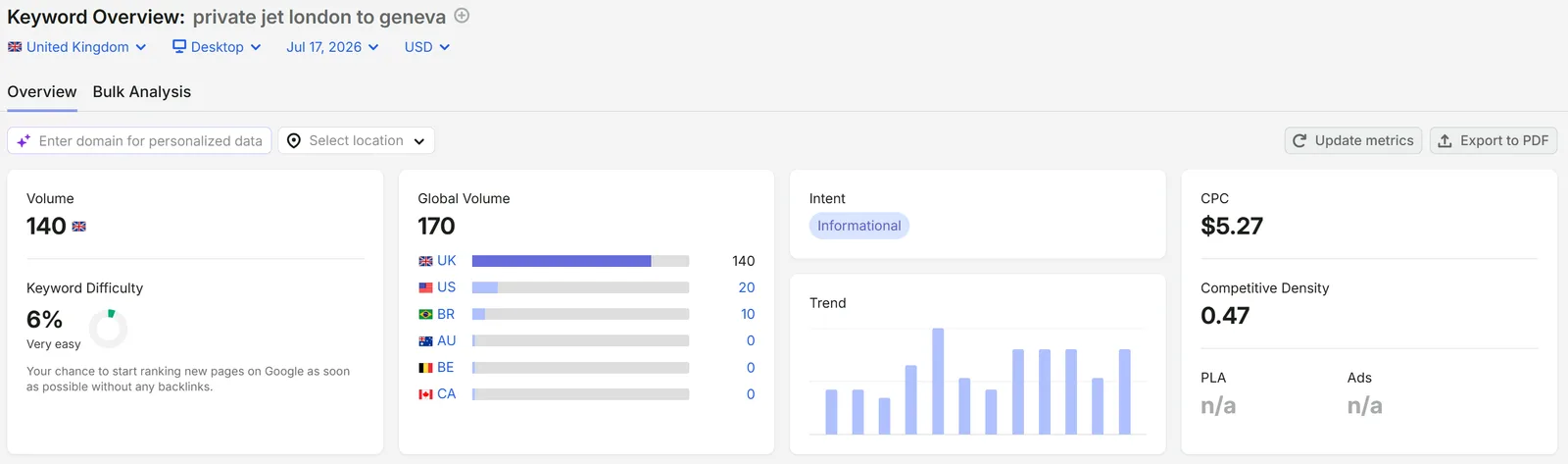
Second, the difficulty score is 6 out of 100. There is an operator-sized gap on page one waiting to be taken.
And Geneva is not unusual. Here is the UK search demand on the major routes out of London (Semrush, July 2026):
| Route keyword | UK searches/month | Keyword difficulty |
|---|---|---|
| private jet london to paris | 320 | 9 |
| private jet to ibiza | 320 | 14 |
| private jet to nice | 260 | 15 |
| private jet london to new york | 260 | 16 |
| private jet london to ibiza | 210 | 12 |
| private jet london to nice | 210 | 9 |
| private jet london to dubai | 170 | 10 |
| private jet london to geneva | 140 | 6 |
Every difficulty score in that table is low. These are winnable terms, with buyers behind them, and operators are contesting almost none of them. For the demand picture across the whole network, see our breakdown of the most popular private jet routes.
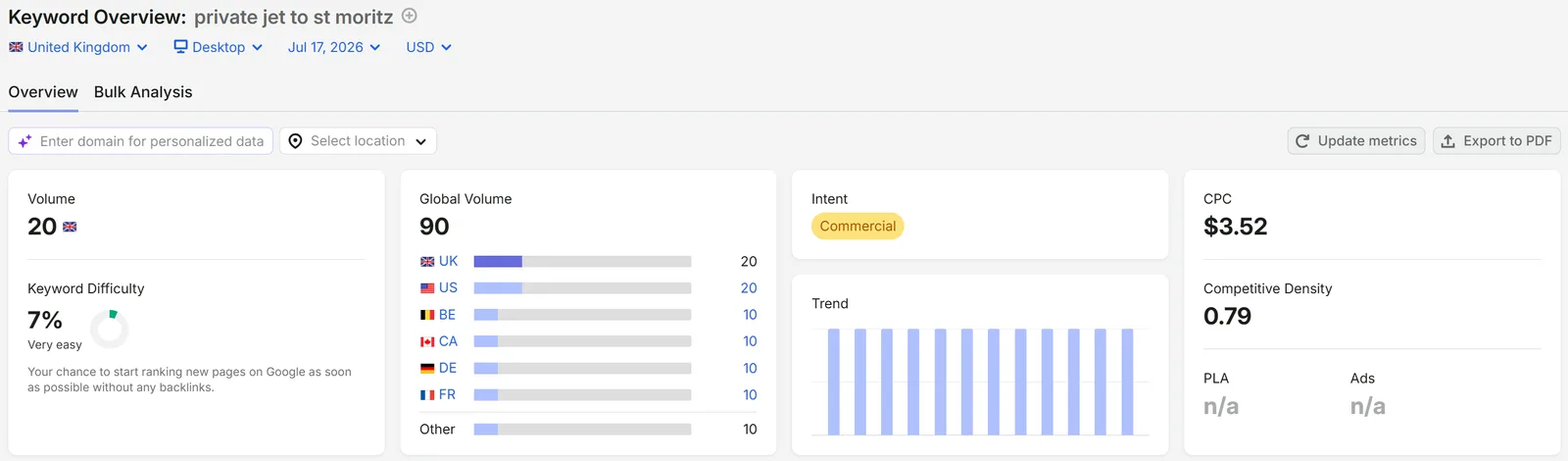
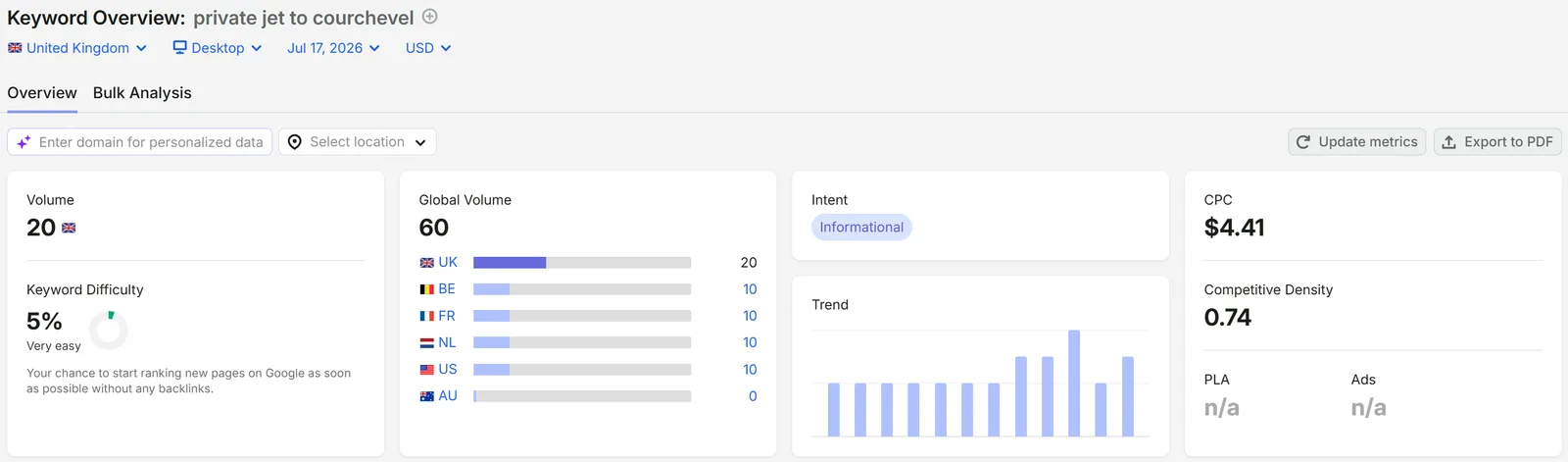
Third, this route is a gateway. The buyer searching London to Geneva in December is often really booking St Moritz, Verbier or Courchevel. Those ski terms have their own search demand, and they all route through Geneva. One route page seeds a whole seasonal cluster. The same logic applies to Formula One weekends, Cannes, and every event in the calendar. Most operators, and most brokers, never build pages for any of it.
Who actually ranks: the broker wall
First step of any audit: search the keyword and look at the lay of the land.
There are Google Ads on the keyword, which is a good sign. People do not pay to advertise on searches that make no money. There is an AI Overview too. And then the organic results: brokers and marketplaces, top to bottom.
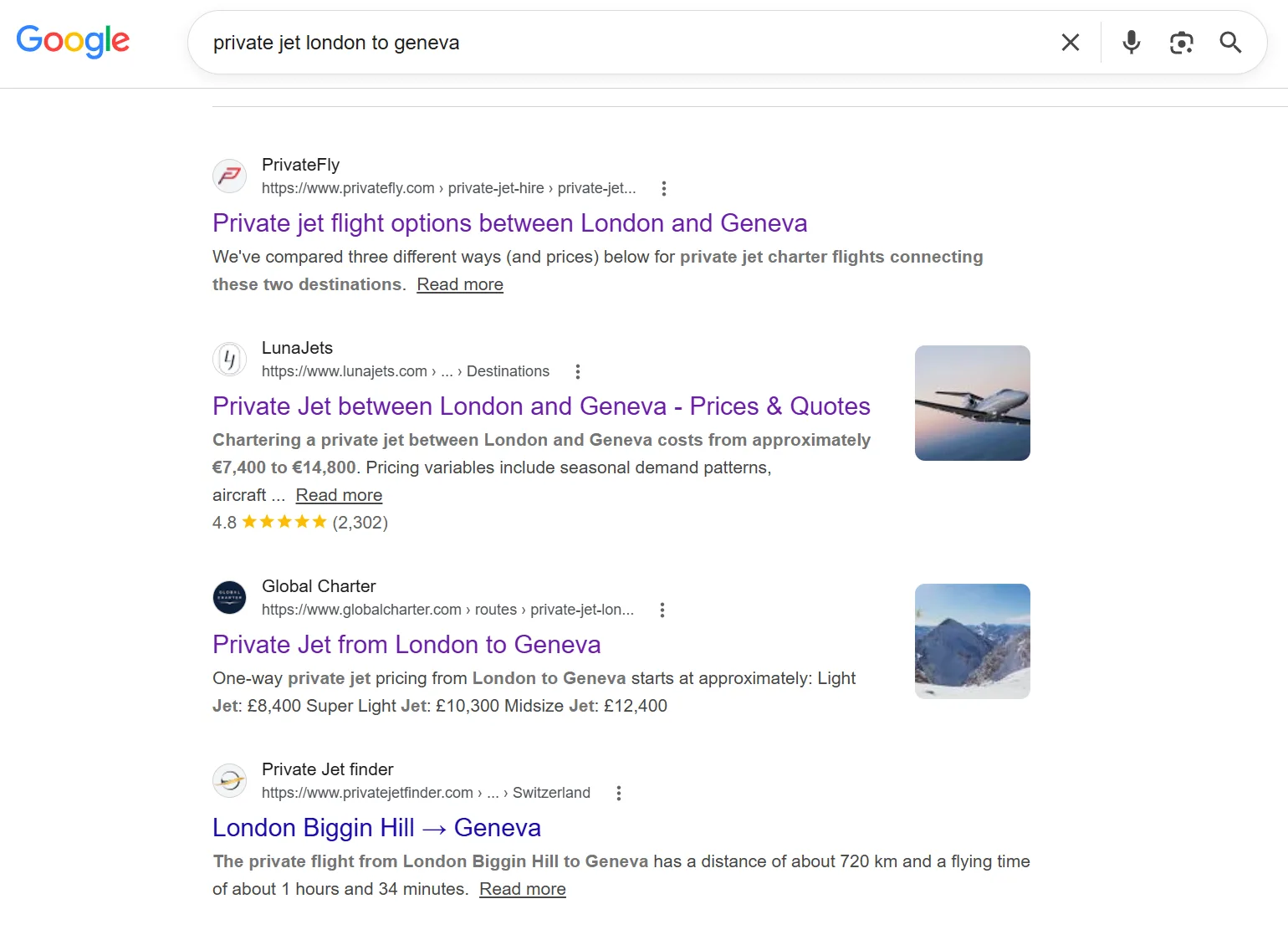
The operator we are auditing appears at position 20. And the page that ranks there is not a route page. It is a generic city page.
This is not one unlucky route. I pulled the top 30 organic results for two major London routes during this audit:
| Route | Results checked | Brokers and marketplaces | Actual operators | Best operator position |
|---|---|---|---|---|
| London to Geneva | Top 30 | 28 | 2 | #20 (with a city page, not a route page) |
| London to Ibiza | Top 30 | 29 | 1 | #25 |
Two routes, 60 results, three operator appearances, none on page one. The companies that own the aircraft are structurally absent from the searches for their own product.
The operator has no route page
This is the pattern I see on almost every operator site. Heavy investment in the homepage: great hero video, beautiful photography, a strong first impression. And that is where it ends.
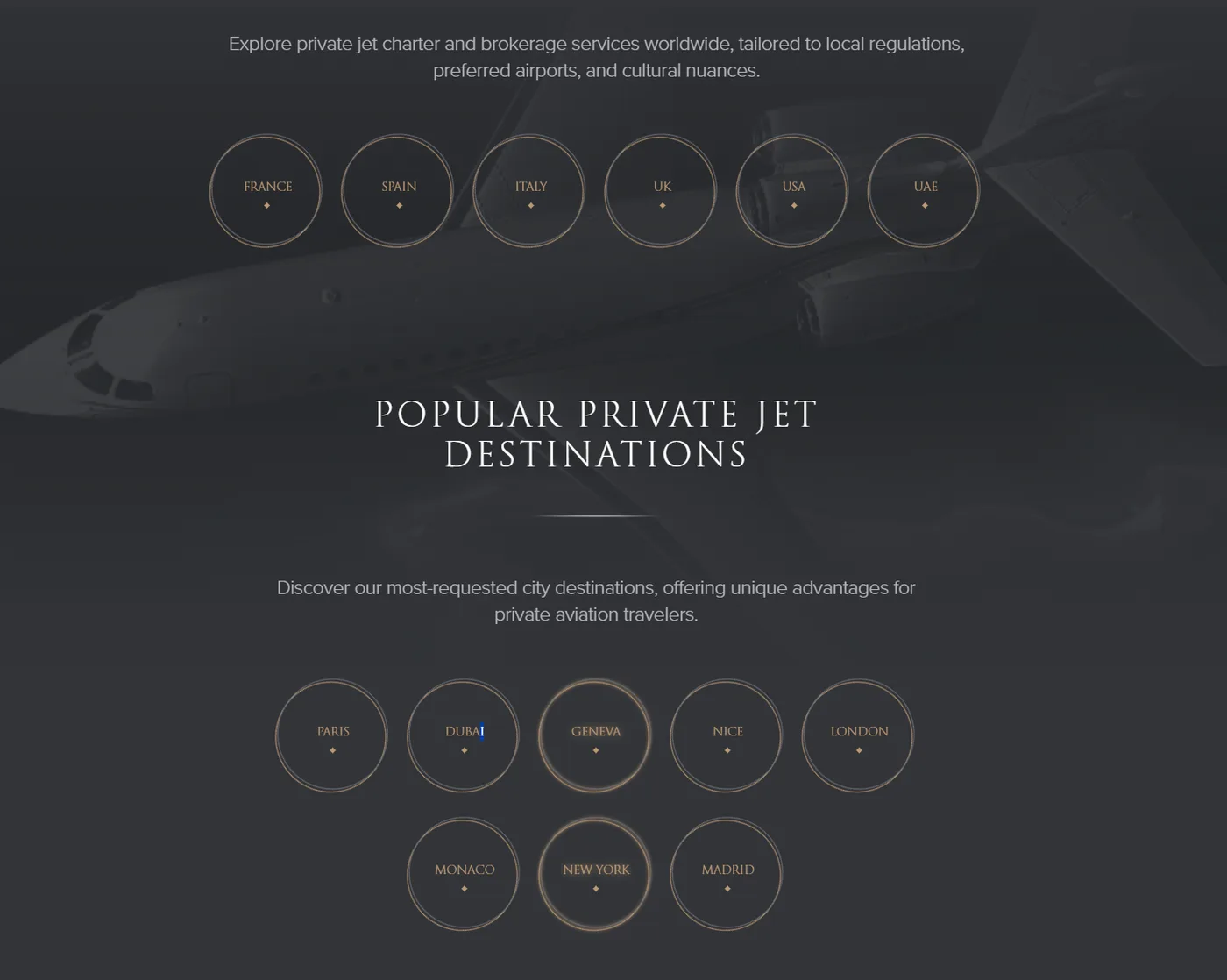
On this site, there is a destinations tab in the menu. It lists countries and cities. They are nearly there. But none of them are clickable. The route names are on the page as plain text. There is no page for London to Geneva, the route the business actually flies.
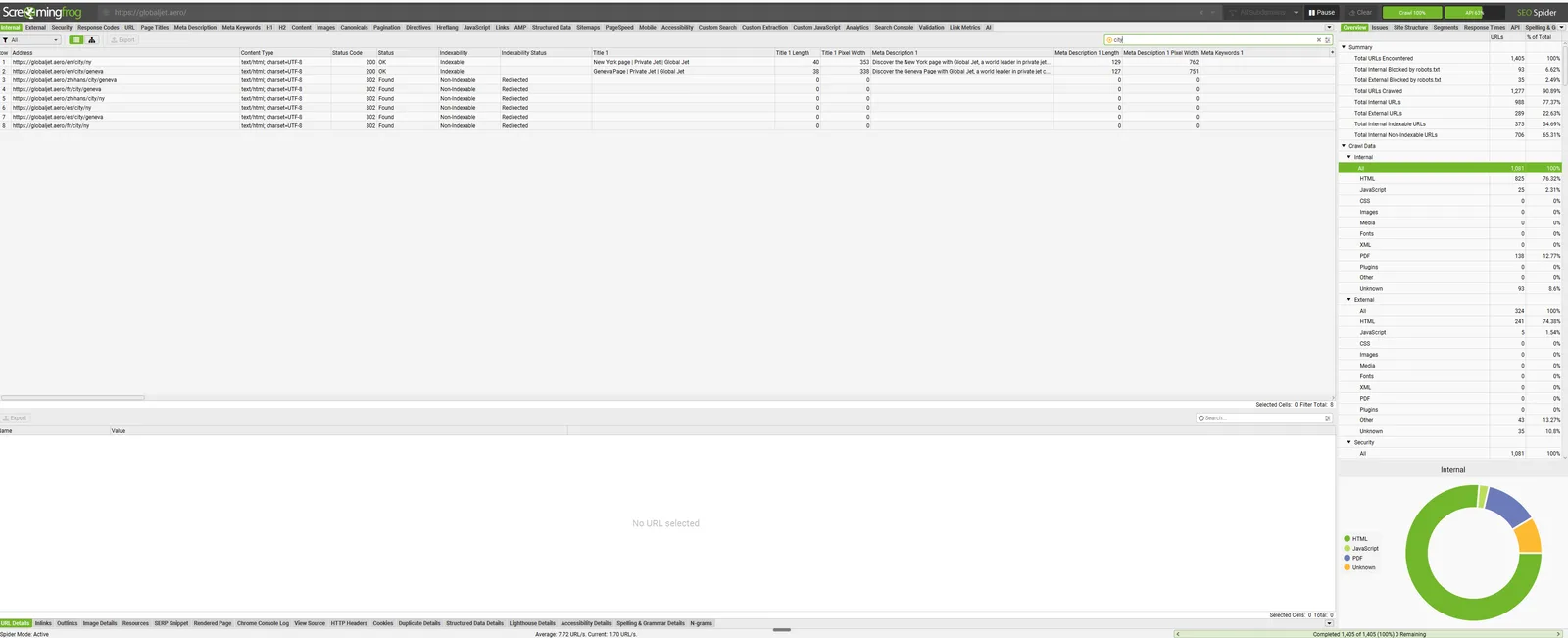
Google cannot rank a page that does not exist. That is the whole problem in one sentence, and it is also the cheapest fix in this audit.
What the pages that beat them contain
I opened the top three ranking pages to see what Google is rewarding. The honest answer: nothing complicated.
The winning route pages have a place to book, visible immediately. Aircraft options by category: light, midsize, heavy. Flight time. Airport pairs. Most of them publish indicative prices. Some link through to individual aircraft pages, which is the right way to build it. FAQs or reviews at the bottom. We break the format down in full in our route page template.
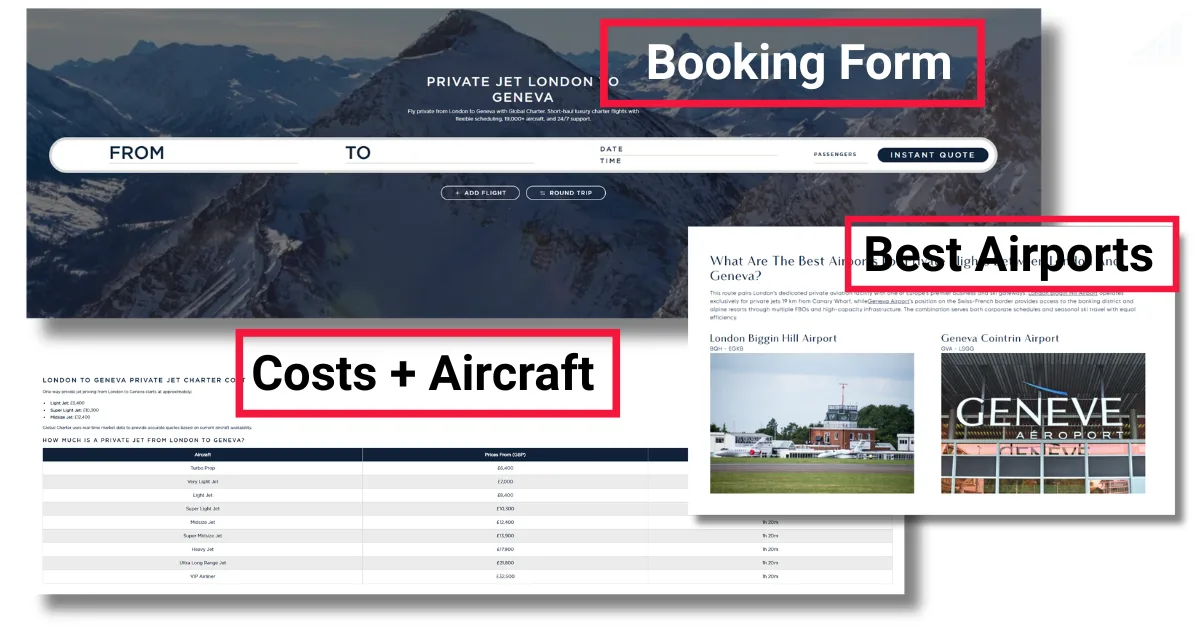
That last point about prices matters more than it looks. When I checked which pages get cited for cost questions, every one of them publishes actual numbers. Operators almost never do. "Request a quote" cannot be quoted by a search engine or an AI. Here is the strange part: this operator does publish price ranges, but they are buried at the bottom of an FAQ on a page nothing links to. The one thing that earns citations, hidden where nothing can find it.
What operators rank for instead: jobs and plane spotters
The operator has strong domain authority and ranks for over 200 keywords. Sounds healthy, until you look at what the keywords are.
Careers. Cabin crew. Flight attendant jobs. Aircraft management. Individual aircraft models. The site's organic traffic is job seekers and aviation enthusiasts, not charter buyers. The commercial route terms, the searches that end in a booking, are almost completely absent.
The keyword profile in one line
226 keywords, almost none of them from buyers. Careers, cabin crew and aircraft model terms dominate; commercial route terms barely register. This is what ranking by accident looks like.
There is nothing wrong with ranking for careers terms. The problem is when that is all there is. If you want to see which terms actually carry buyers, start with the keywords charter buyers actually search.
The AI test: source versus recommended
Google is only half the audit now. The other half is what AI says when a buyer asks.
I opened ChatGPT in an incognito window and typed a real buyer prompt, not a keyword: "How much is a private jet from London to Geneva and who should I book with?"
Two things matter in the answer. Who gets recommended by name, and which websites the answer was built from, the sources of retrieval. These are not the same thing, and the difference is the single most useful idea in this post: you can be a source of retrieval and still not be recommended. Your content can feed the answer while a middleman gets the mention. It is the mechanism behind why AI assistants book your competitors.
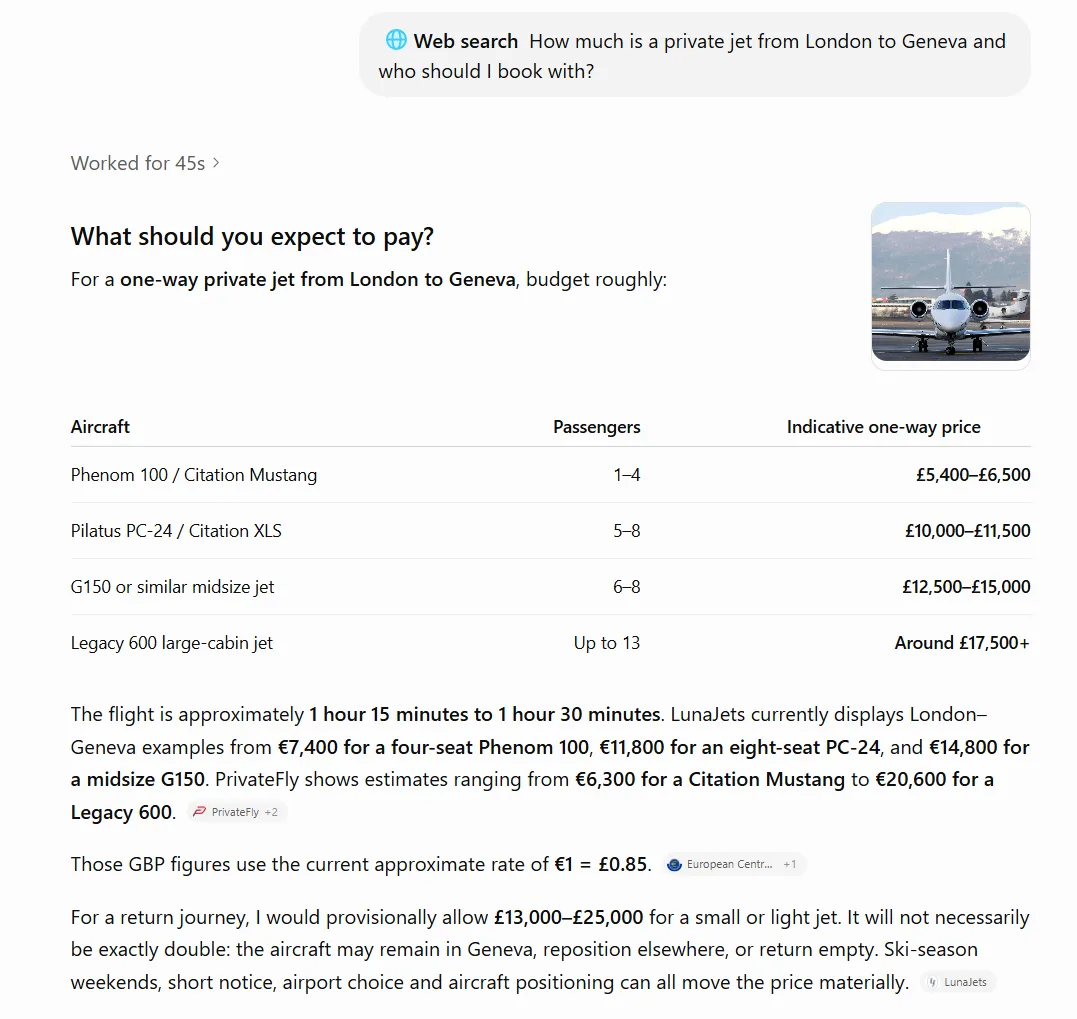
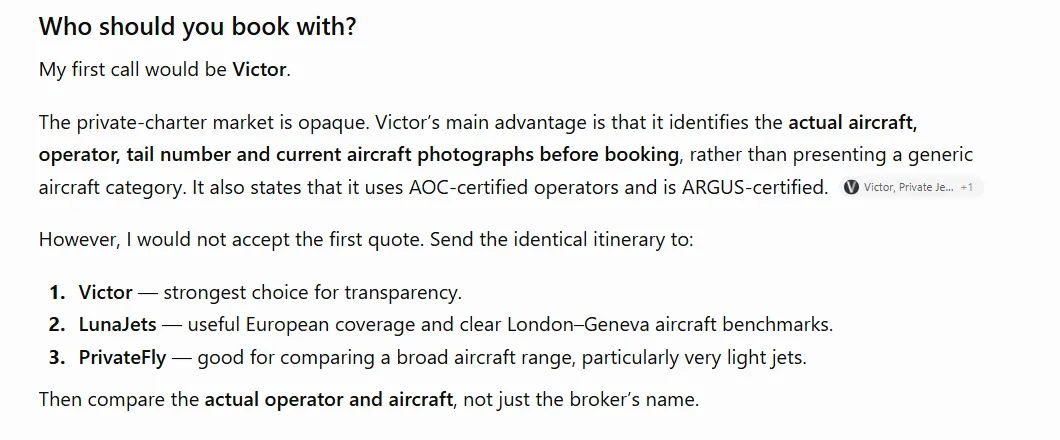
The names ChatGPT recommended were the same brokers from page one of Google. The operator did not appear in the answer. And in the citation panel, the sources ChatGPT read to build that answer, the operator's website did not appear either. On ChatGPT, this operator is not read and not named. Invisible twice.
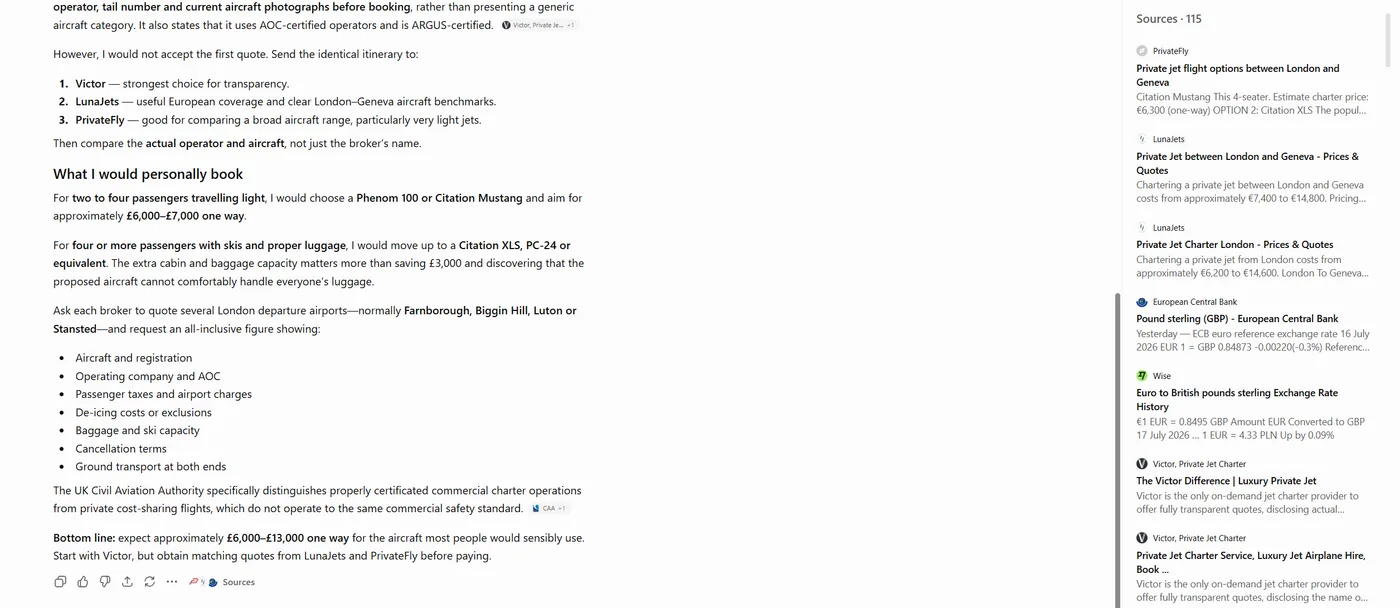
In most industries you would see directories here, the way Checkatrade dominates plumber queries. Aviation barely has that layer. The citations are broker route pages, news outlets, and Reddit. That is bad news for lazy marketing and good news for anyone willing to build: the citation slots are still winnable. Every tactic that helps you win them is collected in our private jet SEO index.
I then tracked the same buyer prompt across eleven AI platforms (ChatGPT, Gemini, Perplexity, Claude, Grok, Copilot, Brave AI, DeepSeek, Meta AI, Google AI Overview and AI Mode) and exported every source they cited. Fifty nine cited pages in total. Here are the top ten:
| # | Cited page | Who it is | Page type | Platforms citing it |
|---|---|---|---|---|
| 1 | globalcharter.com | Broker | Route page (London to Geneva) | 8 of 11 |
| 2 | privatefly.com | Broker | Route page | 8 of 11 |
| 3 | stratosjets.com | Broker | Route page | 6 of 11 |
| 4 | lunajets.com | Broker | Route page with prices | 8 of 11 |
| 5 | privatefly.ch | Broker | Route page (Swiss domain) | 2 of 11 |
| 6 | stirlingaccess.com | Broker | Route page: cost and flight time | ChatGPT |
| 7 | jetfinder.com | Broker | Route page | 4 of 11 |
| 8 | evojets.com | Broker | Route page | 3 of 11 |
| 9 | lunajets.com | Broker | Geneva city page | 2 of 11 |
| 10 | mercuryjets.com | Broker | Route page | 3 of 11 |
Every single one is a broker. Nine of the ten are dedicated route pages, most with published prices. The operator's website appears zero times in all 59 cited sources. The pattern could not be clearer: AI platforms cite route pages with prices on them, and only brokers have bothered to build those.
The non-broker citations further down the list are the opportunity map: Conde Nast Traveler, The Times, Reddit threads, and independent cost-guide blogs. Those are the doors an operator can knock on.
Google rankings do not transfer to AI
A common assumption: rank on Google and the AI visibility takes care of itself. The data says no.
I ran the same prompt through a tracking tool across the AI platforms. Perplexity, Gemini and Grok mirror Google's results closely. Brave and Claude drop off. ChatGPT and Google's own AI modes barely mirror Google at all. The full picture of how each platform behaves is in our guide to private jet AI visibility.
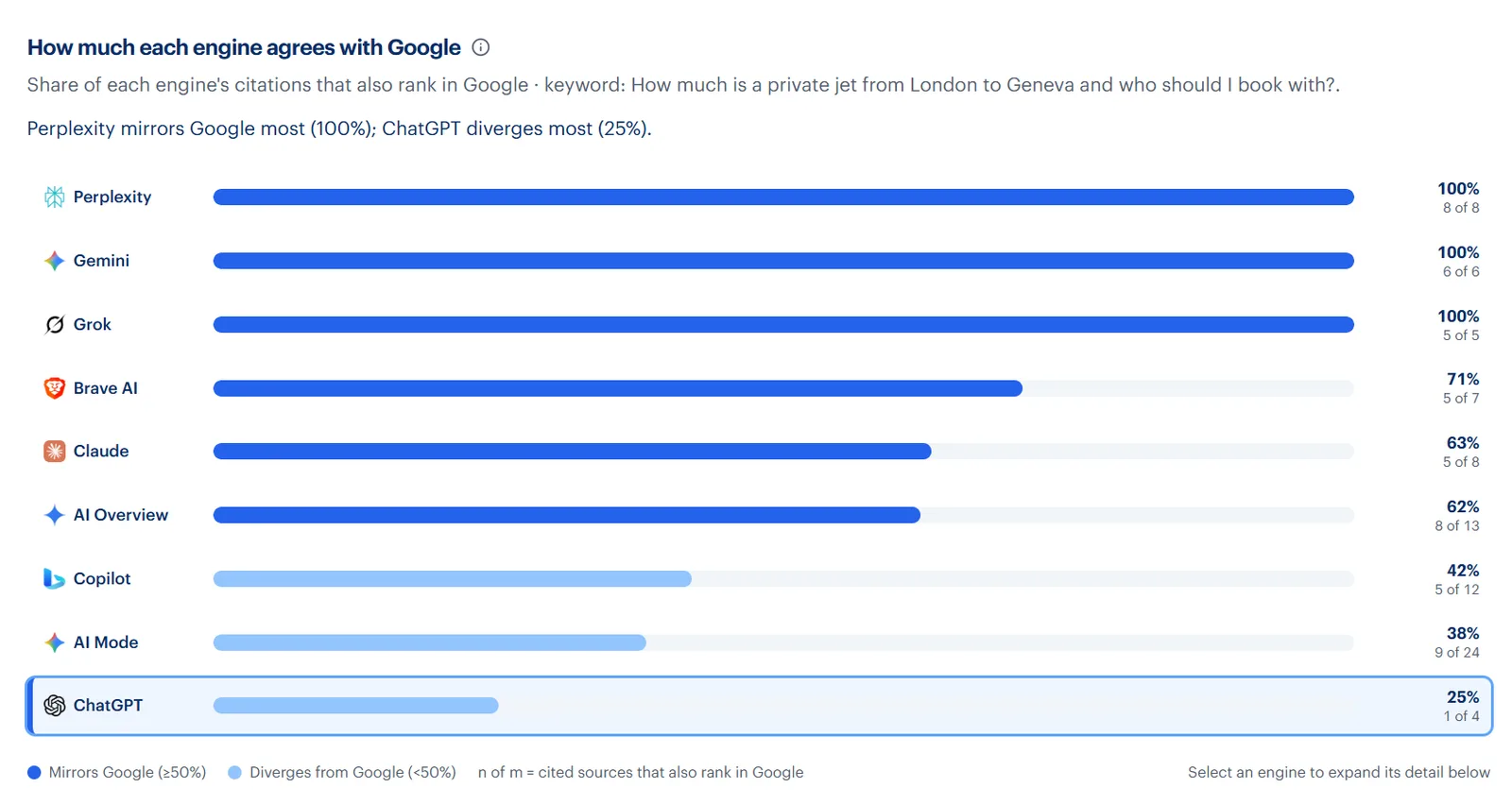
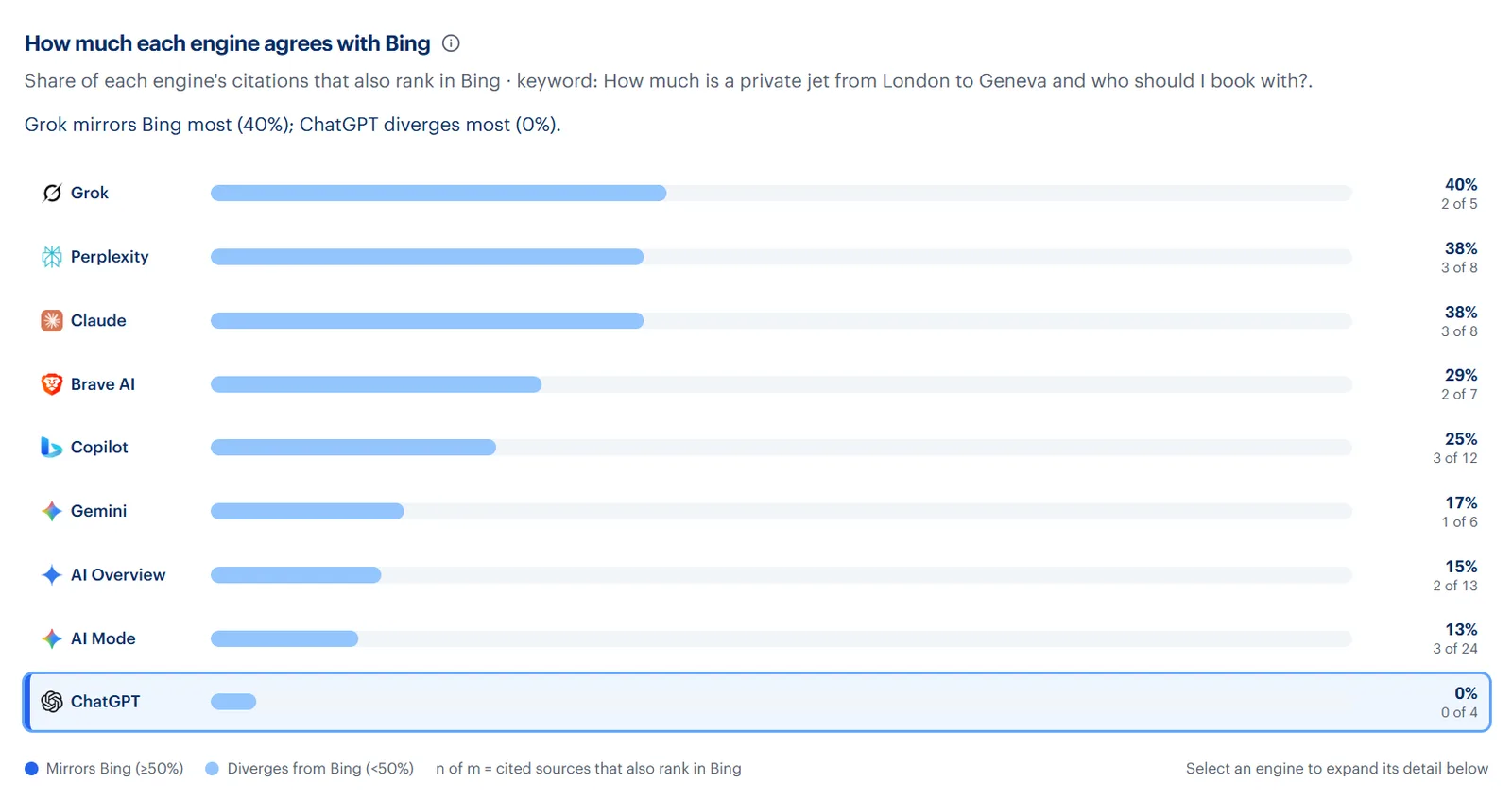
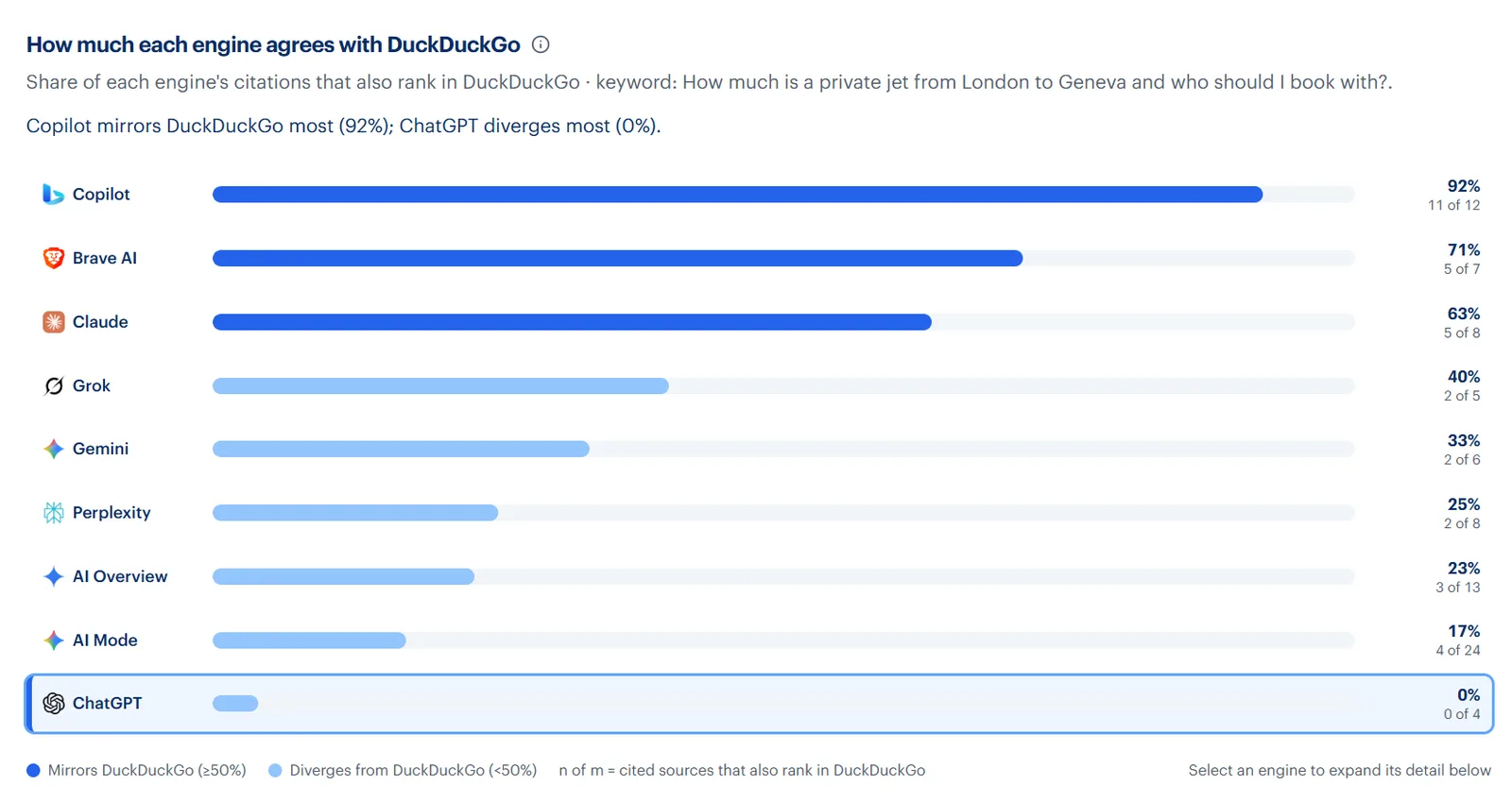
The clearest example from this audit: one major broker ranks number two on Google for this route and is completely invisible on ChatGPT for the buyer prompt. Same brand, same question, same day. If that can happen to a company with a large marketing team, it is happening to operators everywhere.
Here is the full brand visibility table for the buyer prompt, across the eleven platforms tracked (full export, all 20 tracked names, snapshot 17 July 2026):
| Rank | Brand | Type | Platforms | Visibility | Avg. position | Score |
|---|---|---|---|---|---|---|
| 1 | LunaJets | Broker | 9 of 11 | 82% | 2.8 | 82 |
| 2 | Global Charter | Broker | 8 of 11 | 73% | 3.6 | 73 |
| 3 | PrivateFly | Broker | 8 of 11 | 73% | 2.9 | 73 |
| 4 | Jetvice | Broker | 3 of 11 | 27% | 1.7 | 27 |
| 5 | Beechcraft | Aircraft model | 2 of 11 | 18% | 1.0 | 18 |
| 6 | The audited operator | Operator | 2 of 11 (Perplexity, Meta AI) | 18% | 1.0 | 18 |
| 7 | Stratos Jet Charters | Broker | 2 of 11 | 18% | 2.5 | 18 |
| 8 | XO | Marketplace | 3 of 11 | 27% | 7.0 | 16 |
| 9 | Citation | Aircraft model | 2 of 11 | 18% | 2.0 | 16 |
| 10 | Challenger | Aircraft model | 2 of 11 | 18% | 4.0 | 15 |
| 11 | Evo Jets | Broker | 2 of 11 | 18% | 3.0 | 15 |
| 12 | Legacy | Aircraft model | 2 of 11 | 18% | 4.5 | 15 |
| 13 | Mercury Jets | Broker | 2 of 11 | 18% | 4.0 | 13 |
| 14 | Gulfstream | Aircraft manufacturer | 2 of 11 | 18% | 5.5 | 13 |
| 15 | Stratos Jets* | Broker | 2 of 11 | 18% | 5.5 | 13 |
| 16 | TAG Aviation | Operator | 2 of 11 | 18% | 5.0 | 13 |
| 17 | Air Charter Service | Broker | 2 of 11 | 18% | 7.0 | 13 |
| 18 | Victor | Marketplace | 2 of 11 | 18% | 5.5 | 11 |
| 19 | Jet Aviation | Operator | 2 of 11 | 18% | 6.0 | 11 |
| 20 | King Air | Aircraft model | 1 of 11 | 9% | 1.0 | 9 |
Score combines platform coverage and average mention position; higher is better. Rows marked Aircraft model or Aircraft manufacturer are not competitors: they appear because AI answers mention aircraft types when recommending charters. *Stratos Jets and Stratos Jet Charters are the same company, tracked under two name variants. Snapshot 17 July 2026.
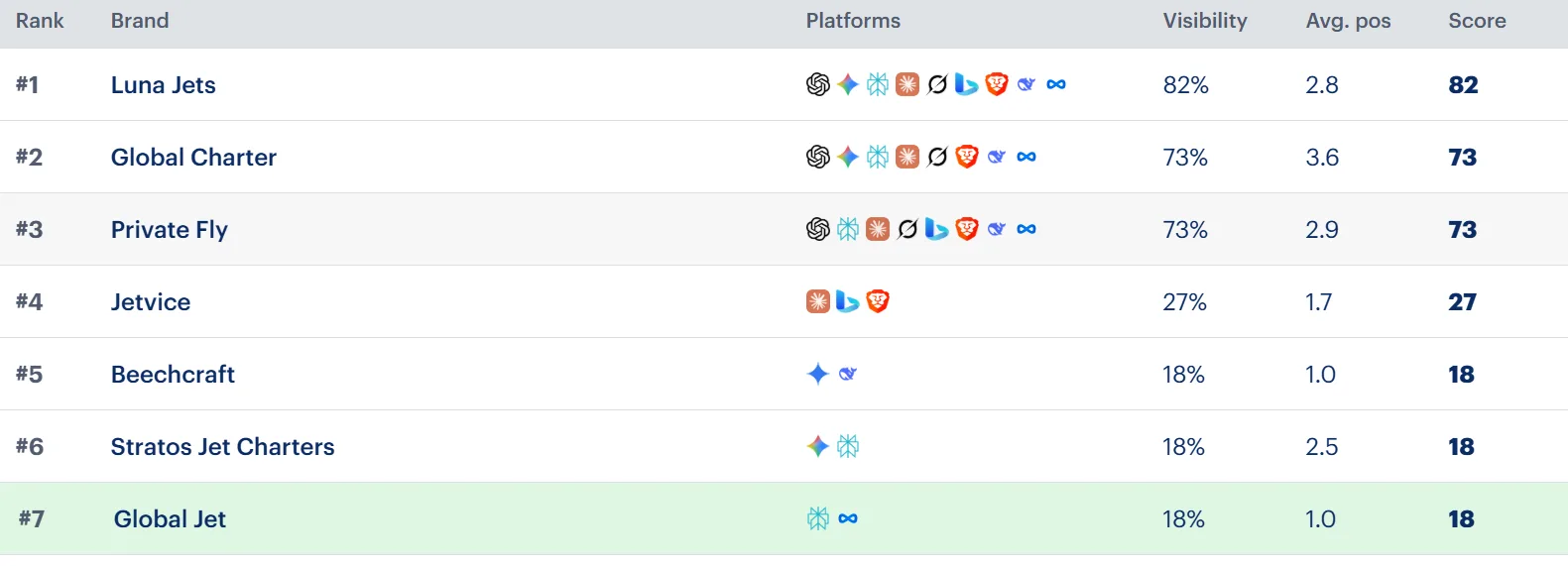
Two honest nuances in this data. First, the operator is not completely absent: Perplexity and Meta AI do mention them, and when Perplexity names them, it names them first. The entity is credible when it surfaces. The problem is how rarely it surfaces: nothing on ChatGPT, Gemini, Claude, Grok, Copilot, Brave, DeepSeek, or Google's AI results. Second, the only fleet operators anywhere in the list sit at 18% visibility or lower, while the top three brokers hold 73% or more. The pattern is structural, not company-specific. The Score column also explains an oddity: XO is mentioned on more platforms than the operator, but scores lower, because its mentions sit seventh in the answers while the operator's sit first. Being named first twice beats being named seventh three times.
The overlooked market: five thousand German searches a month
One more gap, and it is the biggest number in this audit.
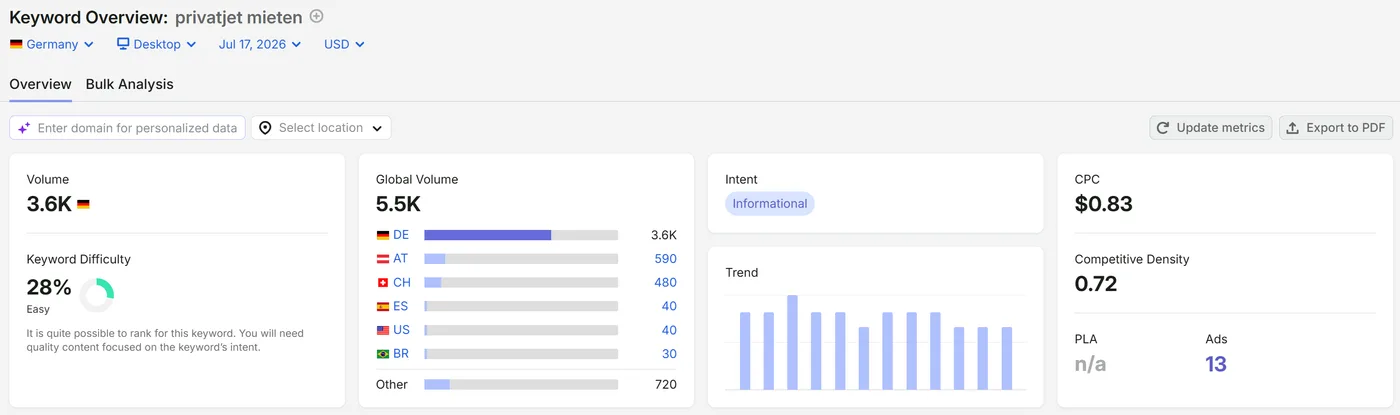
The operator's site is available in English, French, Spanish and Chinese. Not German. Meanwhile "privatjet mieten" (private jet hire) and its variations get roughly five thousand searches a month across Germany, Austria and Switzerland. This is a Geneva-based operator, sitting on the edge of the German-speaking world, invisible in its own neighbourhood's language.
| German keyword | Monthly searches | Market |
|---|---|---|
| privatjet mieten | 3,600 | Germany |
| privatjet mieten | 590 | Austria |
| privatjet mieten | 480 | Switzerland |
| privatjet mieten kosten | 390 | Germany |
| privatjet mieten preise | 390 | Germany |
| privatjet mieten kosten pro stunde | 320 | Germany |
Look at those bottom three rows. Cost, prices, cost per hour. Those are not people writing essays. Those are buyers doing sums, and there is no operator competing for them.
Why this matters now, not next year
Three pieces of context from outside this audit.
Business aviation is busy: global business jet activity is up 3.9% year to date through mid-July 2026 (WingX). The demand exists, and the wider market data in our private jet industry statistics points the same way. The question is only who captures the enquiry.
Buyers have moved: in a G2 survey of over 1,000 B2B software buyers, half said they now start their buying journey in an AI chatbot rather than Google. Charter buyers and their PAs are exactly this kind of professional researcher.
And the traffic is following: ChatGPT referral traffic to websites hit an all-time high in May 2026 (SE Ranking). The channel is no longer theoretical. Operators who are not cited are not in it.
The fix list, in order
If this operator were a client, month one looks like this:
- Build the London to Geneva route page. Prices, aircraft, flight time, airports, FAQs. Then wait for it to index and watch where it lands. With this domain's authority and relevance, my expectation is that it lands well. The exact structure is in our route page template.
- Make the destinations architecture real. Clickable countries, clickable cities, route pages linked from the main navigation, so the site stops hiding its own inventory. This is core private jet SEO work.
- Build the seasonal cluster. Ski resorts first, given the route. Events next.
- Then start on AI visibility. Track the buyer prompts, find the common sources of retrieval, and earn a presence on them: updated articles, guest contributions, linkable data, real PR. Not bought placements. Our GEO guide for charter operators covers the method.
- Open the German market. Translate the route architecture properly, keyword-researched, not word for word.
Notice the order. The route page comes first because everything else compounds on top of it. There is no point being cited by AI for a route you have no page for. And SEO is one channel among several: the full mix is in our guide to how to market a private jet charter company.
Check your own routes in two minutes
You can run the short version of this audit on your own operation right now.
Check one. Google your busiest route. Do not look for your name. Count the brokers. If page one is a broker wall, buyers cannot book direct because they never see you.
Check two. Ask ChatGPT: "how much is a private jet from [your route] and who should I book with?" Look at who is recommended, then look at the sources. Are you read? Are you named?
Check three. Go to your own site and try to click through to a page for that route. A real page, with prices and aircraft. Not a destinations menu that goes nowhere.
If you failed all three, your busiest route is generating bookings for middlemen. The fix is not mysterious, and most of it is listed above.
If you would rather have the full version, with every route and every AI platform documented, that is exactly what the AI Visibility Diagnostic is. Or comment a route on the video and I may audit it publicly in the next episode.
Frequently asked questions
Open ChatGPT in an incognito window and ask a real buyer question, for example "how much is a private jet from London to Geneva and who should I book with?" Check two things: whether you are named in the answer, and whether your website appears in the cited sources. Repeat across your main routes and across other platforms like Perplexity and Gemini, because their answers differ.
A dedicated page for one city pair, for example London to Geneva. A good one includes indicative prices, flight time, suitable aircraft by group size, the airport pairs, FAQs, and a way to request a quote. It is the page Google ranks and AI models cite for that route.
Brokers build route pages at scale and publish prices. Most operators build a beautiful homepage and stop. Google can only rank pages that exist, and AI can only cite answers that are written down. It is an effort gap, not an authority gap: most operators have equal or stronger brand signals than the brokers outranking them.
For a route keyword with low difficulty and an established domain, movement typically shows within weeks of indexing, with rankings settling over three to six months. Results depend on the domain, the competition on each route, and whether the site converts visitors once they arrive.
I run 20 to 30 real buyer queries across ChatGPT, Perplexity and Gemini for your name and your routes, crawl your site, and document every query where a broker or marketplace appears in your place. You get a short visual report showing exactly where you are invisible and who is being named instead. The fee is refundable against month one if we go on to work together.
Sources
- Semrush keyword and SERP data, July 2026
- Rankability AI citation and brand visibility exports, 17 July 2026
- WingX weekly bulletin, global business jet activity, July 2026
- G2 buyer behaviour survey of 1,000+ B2B decision makers
- SE Ranking, ChatGPT referral traffic study, May 2026
All keyword and SERP data from this audit's own Semrush pulls, July 2026. AI citation and brand visibility data from Rankability exports dated 17 July 2026. Positions and AI answers move; re-run the checks for your own routes before acting on any single number.
Related on EpicEdits