The Invisible Fleet Problem
You spent £8 million on a G650.
Your safety record is spotless. Your crew is world-class. Your bases cover the routes UHNW clients actually fly.
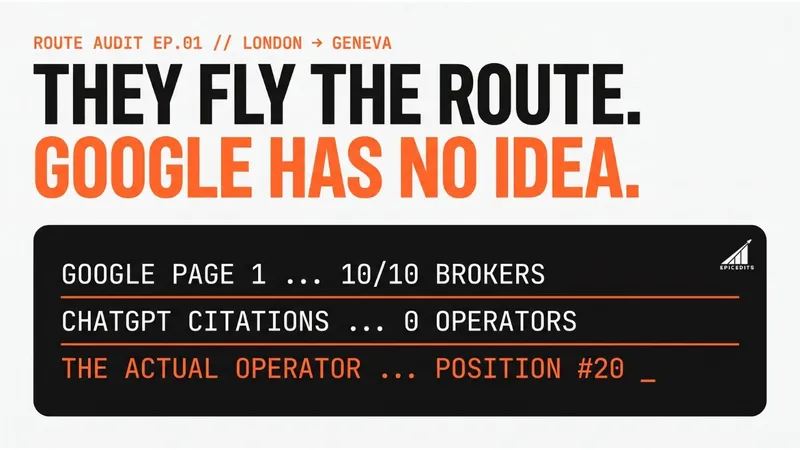
But when a CEO asks ChatGPT "best private jet London to Dubai," your operation doesn't exist.
Not buried on page two. Not ranked lower than competitors. Completely invisible. Understanding how private jet companies get found on Google is only half the battle now, AI discovery is the other half.
The AI cites a broker instead. That broker calls you for availability. You provide the aircraft. The client books. And you pay 17.5% commission on a £45,000 flight that should have been yours from the start.
This isn't a traffic problem. Your site gets visitors. This isn't a brand problem. Your reputation is solid. This is an attribution problem, and it's costing you six figures annually while you watch brokers monetise your own fleet. If you are wondering why most private jet websites fail at SEO, the answer has shifted dramatically in 2026.
The 2026 Discovery Shift
Here's what changed in May 2026: high-intent charter buyers stopped clicking search results. They ask Perplexity which operator flies Teterboro to Aspen with a midsize jet. They ask Google's AI Mode about reposition availability from Nice. They ask ChatGPT to compare safety ratings for transatlantic G650 operators. If you want to understand the full picture of tracking Perplexity mentions for your brand, the shift is already well underway.
And if your fleet data isn't structured for AI private jet SEO, the way these AI engines read and cite information, you don't get the booking. You get the bill from the broker who figured this out before you did.
Why Rankings No Longer Equal Revenue
Traditional SEO taught you to rank for keywords. But AI assistants don't rank, they cite. They pull one authoritative source and present it as the answer. If that source is an aggregator's route page instead of yours, the client never discovers you exist until the broker forwards your tail number in a quote comparison. This is why private jet SEO services must now account for AI citation patterns, not just traditional rankings. Our guide to GEO for private jet charter operators walks through how to become the cited source.
The margin you're losing isn't just the 15-20% commission. It's the direct client relationship, the repeat bookings, the referrals, and the pricing control. Every intercepted lead trains the AI engine that someone else is the authority on your own routes. Use our private jet cost calculator to see just how quickly those commissions compound.
The Broker Commission Tax on Citation Invisibility
| Flight Route | Charter Value | Broker Commission (17.5%) | Annual Loss (Weekly) |
|---|---|---|---|
| London → Dubai | £45,000 | £7,875 | £409,500 |
| Teterboro → Aspen | £28,000 | £4,900 | £254,800 |
| Farnborough → Geneva | £12,500 | £2,188 | £113,750 |
| Nice → London | £15,000 | £2,625 | £136,500 |
Why Traditional Tactics Fail
You've tried adding FAQ pages. You've published blog posts about your fleet. You've paid for directory listings. None of it works because those tactics were designed for human readers and Google's traditional algorithm, not for retrieval-augmented AI models that need machine-readable structured data to understand you even fly the route.
This invisibility compounds. Every day ChatGPT cites a competitor, that competitor's authority signal strengthens. Every week Perplexity recommends a broker for your highest-margin city pair, that broker's citation dominance grows. You're not just losing today's bookings, you're losing tomorrow's algorithmic position.

The Structured Data Gap
"Traditional SEO taught you to rank for keywords. But AI assistants don't rank, they cite."
Your G650 specifications live in a PDF brochure. Your safety certifications sit in an About page paragraph. Your route network exists as a list of city names in your footer.
To human visitors, this looks professional. To AI retrieval systems scanning for authoritative sources to cite, you are functionally illiterate.
How AI Retrieval Actually Works
Here is what happens when a CEO asks Perplexity "G650 operators Teterboro to Aspen with ARG/US Platinum rating": the AI scans thousands of pages in milliseconds, looking for structured signals that match all three criteria, aircraft type, route capability, and safety credential. It finds a broker's database with schema markup identifying fleet specifications, route data tagged with airport codes, and safety ratings wrapped in machine-readable credentials. That page gets cited. Yours does not appear in the consideration set.
This is not about content quality. Your safety record is superior. Your crew training exceeds industry standards. Your G650 maintenance logs are immaculate. But none of that data is structured in the format AI engines require to understand, compare, and cite you as the definitive source. The broader impact of AI search on luxury travel makes this gap more costly every quarter.
What Operators Have vs What AI Needs
| Operational Data | How Operators Present It | What AI Engines Need |
|---|---|---|
| Fleet specs | PDF brochure, About page | Schema-marked aircraft data |
| Route Network | Footer text list | IATA-coded route schema |
| Safety Rating | Certificate logo in sidebar | Verified Credential markup |
| Availability | Contact form | Machine-readable positioning data |

The Algorithmic Compounding Effect
The cost of inaction isn't just today's lost commission. It's the permanent loss of algorithmic authority. Every time an AI cites a competitor for a route you fly, that source's "weight" in the model increases. The AI learns that the competitor is the authoritative source for your highest-margin city pairs.
By 2026, this creates an unbridgeable gap. An operator with Sovereign Citation Architecture achieves 90% citation rates for their core routes, while operators without it remain at 0%. This isn't a linear race, it's an exponential one. Early adopters are training the AI models that they own the market. You are training the models that you don't exist.
"You are training the AI models that you don't exist."
Stop letting brokers own your discovery layer. Claim your Sovereign Citation Architecture.

Winning Back Your Bookings
The solution is to build Sovereign Citation Architecture, a technical and content framework that makes your operational advantages computable. It involves converting your fleet specs, route networks, and safety records into the structured data formats that AI retrieval systems prioritise. This is exactly what our AI SEO strategy delivers for charter operators.
By owning your data structure, you win back the bookings that are currently being intercepted by brokers. You eliminate the 17.5% commission tax. You own the direct client relationship. And you train the AI models that you are the definitive authority on the routes you fly.
Run Your Own Visibility Audit
You do not have to guess whether AI can see your fleet. You can test it today. This is the invisible gatekeeper problem in plain terms. A client types a question into a chat box. The answer names a source. If that source is not you, you lost the booking before you knew it existed.
Open ChatGPT, Perplexity, or Gemini. Ask a question your best clients ask. For example: "Who is cited for private charter pricing between Teterboro and Nantucket in June 2026, and why?" Try it with your own routes, your tail numbers, and your aircraft types. For each answer, save three things: the exact URL cited, the answer summary, and the time of your query.
If the answers are vague or name a competitor, you are losing money. This loss is hard to spot. The client never visits your site. Your analytics show nothing. That is why so many strong operators miss it.
The 7-Day Audit Workflow
A full audit takes about a week. Spread the work across seven short days. First, list the ten questions clients ask most. Next, run each one in ChatGPT, Perplexity, and Gemini and capture the results. Then backtrack the sources. For answers with no citation, work out the likely source with a normal Google search.
After that, inspect the cited pages for schema markup and machine-readable data. Group the sources by type and score each one for authority. Plot your content gaps on an impact-versus-effort grid. Finish by writing a 90-day plan with owners and deadlines.
The 90-Day Turnaround
Weeks one to three are for the audit. Run the full visibility test. Map competitor citations. Mark the quick wins. Weeks four to eight are for publishing. Build three to five structured asset profiles. Add JSON-LD to your key pages. Turn your PDF brochures and safety certificates into web pages with clear metadata.
Weeks nine to twelve are for amplifying. Reach out to trusted aviation sources. Earn links from pages AI systems already cite. Then watch your citation share and repeat the test each month. Small, structured changes can win citations within weeks.
Frequently Asked Questions
Sovereign Citation Architecture is the practice of converting your operational data, fleet specs, route networks, safety credentials, base locations, into machine-readable structured formats that AI engines like ChatGPT, Perplexity, and Google AI can discover, compare, and cite. Instead of describing capabilities in marketing prose, you encode them in schema markup that makes your competitive advantages computable.
Brokers build route databases where every city pair is a separate page with schema markup, aircraft options tagged with specifications, and pricing structured as ranges. AI retrieval systems scan for structured signals that match query intent. Operators typically describe capabilities in paragraph form on About pages and fleet pages, which AI cannot extract, compare, or cite as authoritative answers.
Broker commissions typically run 15-20% of charter value, with 17.5% being industry standard. For a weekly London to Dubai G650 charter at £45,000, that is £7,875 per flight or over £409,000 annually. Beyond commission costs, operators lose direct client relationships, repeat booking potential, referral networks, and pricing control.
Initial structured data implementation for core routes and fleet typically takes 4-8 weeks. Citation results begin appearing within 2-4 weeks of deployment as AI retrieval systems index structured content. Full algorithmic authority for high-priority city pairs usually establishes within 3-6 months, depending on route volume and competitive landscape.
Five core elements: aircraft specifications tagged with schema markup (make, model, range, certification), route data structured with IATA codes and geographic coordinates, safety credentials wrapped in credential schema linking to third-party sources like ARG/US or Wyvern, base locations encoded with airport identifiers, and availability signals indicating positioning and response time.
Traditional SEO remains important for Google organic rankings, but it is no longer sufficient. AI assistants do not rank pages, they cite authoritative sources. An operator can rank well on Google but remain completely invisible to ChatGPT and Perplexity if their content lacks the structured data these retrieval systems require. The most effective approach combines traditional SEO foundations with AI-specific citation architecture.
Yes. AI citation architecture does not require breadth, it requires depth on the routes you actually fly. A small operator with 10 highly-structured route pages for their core city pairs can win citations over a large broker for those specific routes. The key is making your operational advantages (direct pricing, guaranteed availability, crew continuity) machine-readable and comparable.
Every time an AI system cites a competitor or broker for routes you fly, that source’s algorithmic authority strengthens. The AI model learns to prefer that source for similar future queries. After 12 weeks, a competitor with citation architecture can achieve 90% citation rates while operators without it remain at 0%. The gap is not linear, it is exponential, making early action critical.
AI retrieval systems like ChatGPT and Perplexity use retrieval-augmented generation (RAG) to scan thousands of pages for structured signals matching query intent. They prioritise sources with machine-readable data that directly answers the query, structured route data, tagged aircraft specifications, and verifiable credentials. Marketing prose and brand messaging provide zero structured signals for citation.
Start with an AI visibility audit of your highest-margin routes. Check whether your fleet data, route information, and safety credentials appear in ChatGPT and Perplexity responses. Then prioritise 5-10 core city pairs and build structured route pages with schema markup, IATA codes, aircraft assignment, and availability signals. This targeted approach delivers measurable citation improvements within weeks.
Sources
- IATA Digital Marketing Benchmarks for Private Aviation, 2026
- EpicEdits - Private Aviation AI Citation Analysis Report, May 2026
- Search Engine Journal - Impact of AI Overviews in Luxury Verticals
- ARG/US International - Safety Data Standards for Digital Discovery