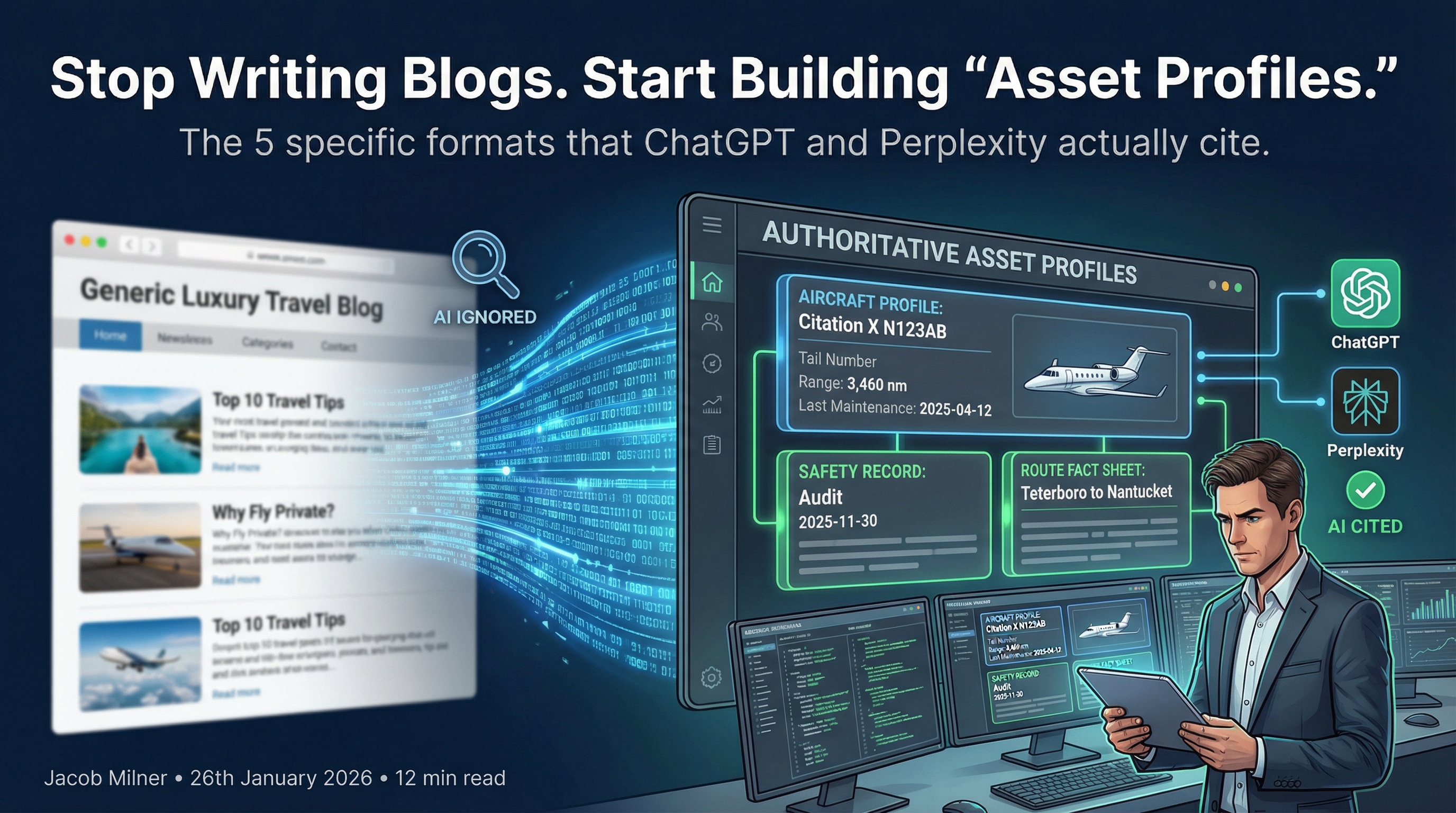
AI answer engines prioritise certainty over creativity. They cite sources with verifiable facts, persistent identifiers, and structured metadata—not "Top 10 Travel Tips" blog posts. This article teaches you to pivot from content marketing to authoritative asset publishing, covering the 5 asset types AI systems trust and the "machine-focused summary" technique that gets your content extracted.
Why "Luxury Travel Tips" Don't Work
Most private jet websites produce the same content: "Five Reasons to Fly Private," "The Benefits of Charter Travel," "Luxury Destinations for 2026." These posts might generate some social shares, but AI systems completely ignore them when answering specific charter queries.
Why? Because AI answer engines crave certainty. They're looking for:
- Verifiable facts tied to identifiers (tail numbers, certificate IDs)
- Structured data using Schema.org vocabulary that can be parsed and extracted
- Timestamps that prove the information is current
- Concise answers formatted for direct extraction
Generic blog content provides none of this. When someone asks Perplexity "What's the range of a Citation X?" or ChatGPT "What's the hourly rate for a light jet from Teterboro to Nantucket?", AI systems cite pages with specific, verifiable data—not lifestyle content. Understanding why your fleet is invisible to AI is the first step.
The pivot is clear: Move from "content marketing" to "authoritative asset publishing."
The 5 Assets That Get Cited
Based on analysis of what AI systems actually cite for private aviation queries, these are the five asset types that function as primary sources:
1. Aircraft Profiles
Tail-number-specific pages (not generic "Heavy Jet" categories). 600-1,200 words per aircraft.
2. Safety & Compliance Records
Compact record pages with dated entries for inspections, audits, and certifications. 300-800 words per record set.
3. Route Fact Sheets
One page per route or city pair with flight data. 200-500 words per route.
4. Transparent Pricing Examples
Representative booking examples with line items and validity dates. 300-600 words per example.
5. Case Study Itineraries
Detailed travel scenarios showing end-to-end planning. 500-1,000 words per case study.
The Secret Weapon: The "Machine-Focused Summary"
Here's the technique that dramatically increases citation probability: Place a 50-200 word factual summary at the very top of your page—before any marketing copy, hero images, or navigation elements.
This "Quick Answer" should be written exactly as you'd want an AI to summarise your content. It should:
- Answer the core question in the first sentence
- Include the key identifier (tail number, route, certification ID)
- Provide 2-3 supporting facts with specific numbers
- End with a verification note or source reference
Example Machine-Focused Summary
MACHINE-FOCUSED SUMMARY (50-200 words)
"The Citation X with tail number N123AB has a published range of 3,460 nautical miles at long-range cruise with four passengers and standard reserves. This aircraft features an 8-passenger cabin configuration, Rolls-Royce AE 3007C engines, and achieved its last 'A' inspection on 2025-04-12. Typical hourly rate starts at $4,800 USD inclusive of crew. For certificate details, consult FAA Airworthiness Certificate AC-2021-7843. Last updated: January 2026."
This summary appears first on the page—in visible HTML, not hidden metadata. AI crawlers extract this concise answer and use it directly in responses, citing your page as the source.
How to Structure Each Asset
Use this consistent header block at the top of every asset page:
| Field | Purpose | Example |
|---|---|---|
| Title | Clear, searchable asset name | Citation X N123AB Aircraft Profile |
| Asset Type | Category for organisation | Aircraft Profile |
| Persistent Identifier | Unique, verifiable reference | Tail Number: N123AB |
| Publish Date | When content was created | 2026-01-15 |
| Last Updated | When content was last verified | 2026-01-26 |
| Author/Team | Responsible party | Operations Team |
| Licensing Terms | Reuse permissions | CC BY 4.0 |
| Contact | Verification contact | data@yourcompany.com |
Micro Q&A Snippets: Your Citation Multiplier
Beyond full asset profiles, create 25-50 micro Q&A snippets that answer specific questions discovered in your visibility audit. Each snippet should be:
- 50-200 words maximum
- Answering a single, specific question
- Including at least one persistent identifier
- Ending with a one-sentence verification note
These micro snippets can live on their own pages, within larger asset profiles, or as structured FAQ sections. They match exactly how users query AI assistants: "What's the range of...?", "How much does it cost to...?", "What are the safety requirements for...?"
Common Pitfalls to Avoid
Avoid long marketing copy without structure. Put the summary and identifiers at the top.
Never publish content without serial numbers, tail numbers, or certificate IDs where relevant.
If reuse terms are missing, AI teams will avoid citing the page. Provide simple language like "CC BY-SA" or "Contact for permission."
Avoid temporary or session-based links. Use stable, HTTPS URLs and maintain redirects when content moves.
Real-World Results
Case Study: Mid-Atlantic Charter Operator
A regional operator published aircraft profiles for its
five most-used jets, including tail numbers, maintenance logs,
and one-paragraph Quick Answers. Within eight weeks, the
operator began appearing as a cited source for queries about
aircraft specs and safety in Perplexity answers. The operator
reported a 22% increase in direct inquiry conversions from
pages with clear "Cite This Page" snippets. This approach
aligns with
verification-based SEO strategies
that earn the "trusted source" badge.
Case Study: Boutique Broker
A broker
created 15 route fact sheets and 30 micro Q&A snippets
focused on weekend leisure trips. Aggregators ingested the CSV
schedule feed the broker published, and within three months an
industry travel site linked to the route pages. The broker saw
a measurable lift in branded queries and an uptick in quoted
pricing requests. For operators wanting
expert guidance on private jet SEO, these asset profile strategies form the foundation of
effective AI visibility.
Get the Asset Profile Templates
Don't start from scratch. Our AI Visibility Playbook includes ready-to-use templates for all 5 asset types, complete with metadata fields, machine-focused summary examples, and "Cite This Page" snippets.
Frequently Asked Questions
Whether you're a new client or a long-time partner, we're here to help. Below are answers to the most common questions.
A blog post is typically narrative, time-bound content like 'Top 10 Travel Tips.' An asset profile is an authoritative, evergreen reference page tied to a specific identifier—like a tail-number-specific aircraft page or a route fact sheet. AI systems cite asset profiles because they contain verifiable, structured facts with persistent identifiers.