Technical SEO
Technical SEO Checklist for Aviation Websites
 Jacob Milner·Founder, EpicEditsPublished May 17, 2026
Your aviation website might look brilliant, but if the technical SEO is broken, Google doesn't care. Here's how to fix it.
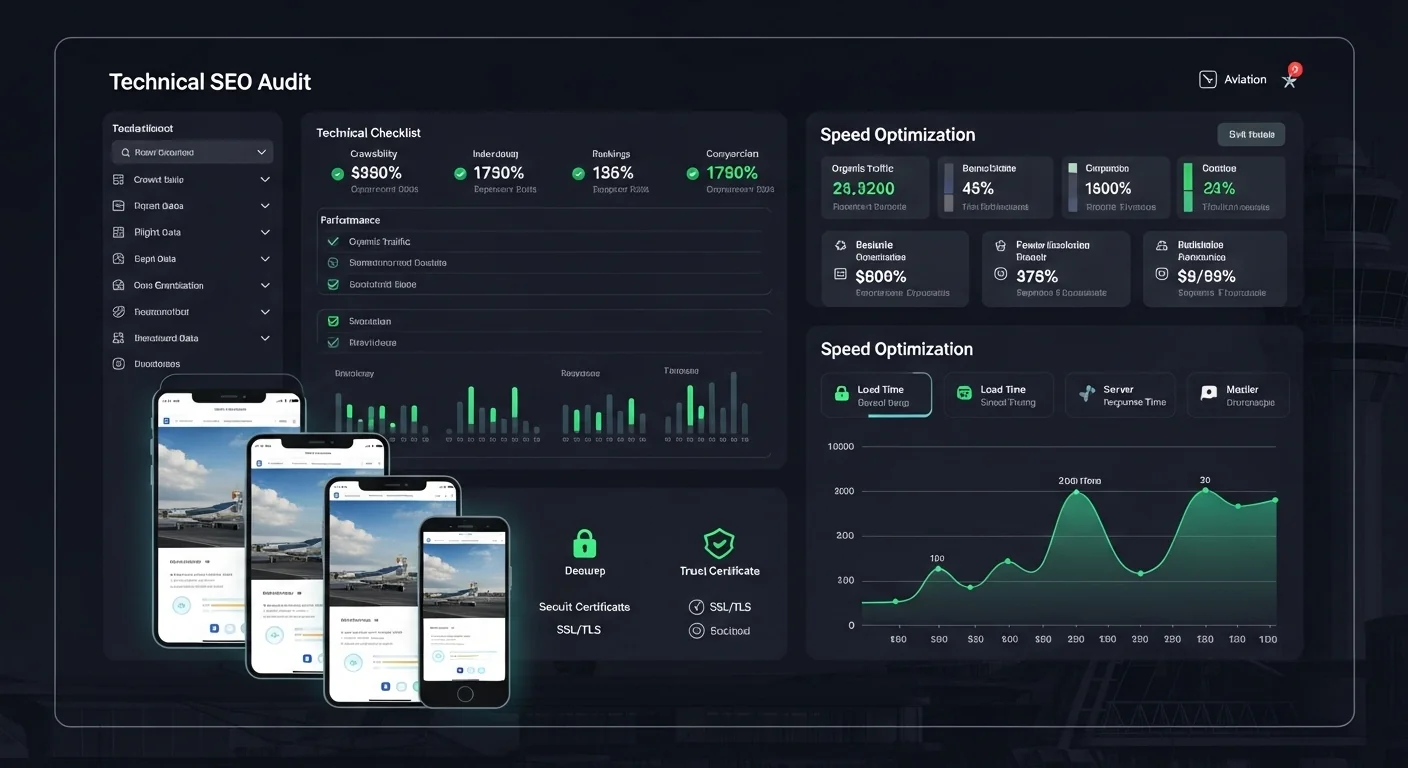
I was looking at an FBO's website last week. Beautiful design. Stunning aircraft photos. Video backgrounds. The works. Then I ran a technical SEO audit. Page speed score: 23 out of 100. Mobile usability: failing. Core Web Vitals: all red.
Here's what nobody tells you: **technical SEO for aviation websites** matters just as much as your content. Actually, scratch that. It matters more. Because if Google can't properly crawl, index, and serve your site, all that beautiful content is worthless. For charter operators specifically, our private jet technical SEO service addresses the unique challenges aviation sites face.
This isn't theoretical stuff. I've seen aviation companies spend £20k on website redesigns and actually rank *worse* afterwards because nobody checked the technical foundations.
Why Is Technical SEO Different for Aviation Sites?
Aviation websites have unique challenges. You've got massive image galleries (aircraft interiors, exteriors, fleet photos). You've got route calculators and booking systems. You've got multiple location pages for FBOs. All of this can absolutely tank your technical SEO if done wrong.
The Stakes Are High:
- •Google uses page speed as a ranking factor. Slow site = lower rankings.
- •Mobile-first indexing means your mobile site determines your rankings, not desktop.
- •Crawl budget matters. If Google wastes time on broken pages, it won't index your good ones.
- •Technical issues cause indexation problems. Your pages might not even be in Google's index.
Right, let's get into the actual checklist. I'm going to assume you've got basic access to Google Search Console and can either speak to your developer or work with an agency like EpicEdits to implement these fixes.
How Do You Optimise Page Speed for Aviation Websites?

Here's a fun stat: for every second your page takes to load, conversions drop by 7%. Your potential clients are busy people. They're not waiting around for your 10MB hero image to load.
The Speed Checklist:
Compress All Images
Use WebP format instead of JPG/PNG. It's 30% smaller with the same quality. Tools like ImageOptim or TinyPNG work brilliantly. For aviation sites with dozens of aircraft photos, this alone can save 5+ seconds of load time.
Tool: TinyPNG or ShortPixel for bulk compression
Enable Lazy Loading
Don't load images until the user scrolls to them. If you've got a page showcasing your entire fleet, there's no reason to load all 50 aircraft images immediately. Lazy loading cuts initial page weight by 60-70%.
Minify CSS, JavaScript, HTML
Remove all unnecessary characters, whitespace, and comments from code files. This sounds technical, but most hosting platforms (like Cloudflare) can do this automatically.
Use a CDN (Content Delivery Network)
Store copies of your site on servers worldwide. Someone in Dubai loads from a Dubai server, not your London one. Cloudflare's free tier works great for most aviation sites.
Enable Browser Caching
Tell browsers to store certain files locally. Return visitors load way faster because they're not re-downloading your logo, CSS, and scripts every single time.
How Do You Optimise Aviation Websites for Mobile?

Bit of a reality check: over 65% of private jet searches start on mobile. Someone's stuck in traffic, pulls out their phone, and searches "private jet London to Monaco." If your site looks rubbish on mobile, they're booking with your competitor.
Responsive Design (Non-Negotiable)
Your site should automatically adapt to any screen size. Test on actual devices, not just Chrome's developer tools.
Tap Targets Minimum 48x48 Pixels
Buttons and links need to be big enough to tap with a thumb. Google actually penalises sites for this.
Security & Trust Signals

Private jet clients are risk-averse. They're about to spend thousands on a flight. If your site says "Not Secure" in the browser bar, you've lost them before they even read your fleet list.
Crawlability & Indexation
If Google's bots can't find your pages, you don't exist in search results. Fix your site architecture, sitemaps, and robots.txt.
Frequently Asked Questions
Aviation websites have unique challenges including massive image galleries, route calculators, booking systems, and multiple location pages for FBOs. All of this can tank your technical SEO if done wrong.
Aviation websites should load in under 3 seconds. For every second your page takes to load, conversions drop by 7%. Use image compression, CDN, lazy loading, and minified code to achieve this.
Over 65% of private jet searches start on mobile. Google uses mobile-first indexing, meaning your mobile site determines rankings. Poor mobile experience means lost bookings.
Yes, absolutely. Google gives preference to secure sites, and showing 'Not Secure' to someone about to spend £50,000 on a flight destroys trust. HTTPS is non-negotiable.
Fix broken internal links, eliminate orphaned pages, create a logical site architecture, submit XML sitemaps, and use robots.txt properly. Google's bots need clear paths to find and index your content.