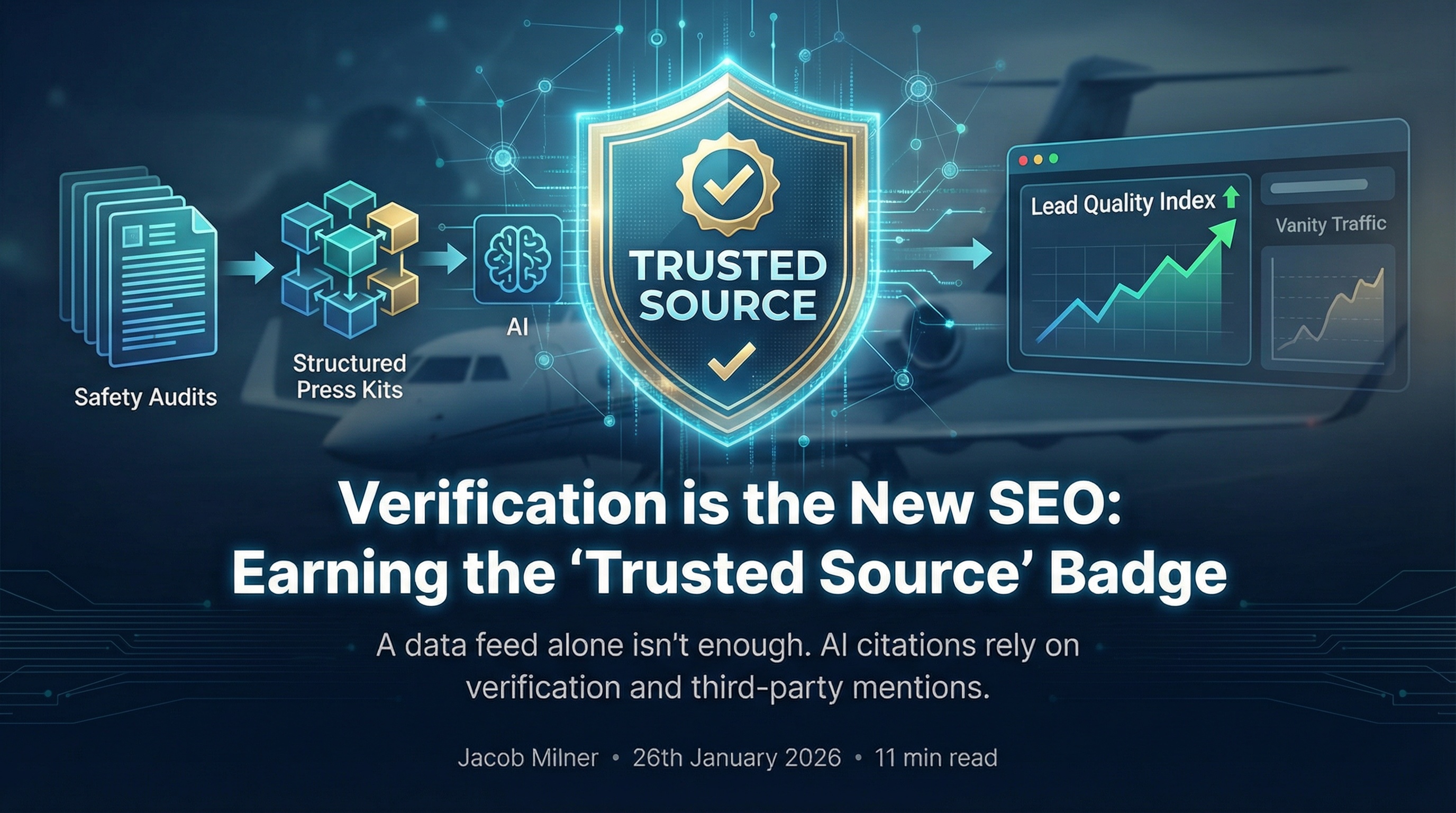
Publishing machine-readable data is half the battle. AI systems also evaluate trust through verification and third-party mentions. This article teaches you to transform routine safety audits into "Structured Press Kits" that earn citations, build verification layers that prove your authority, and measure success through Lead Quality Index rather than vanity traffic metrics.
From Brand Awareness to Entity Authority
You've published machine-readable data feeds. You've added JSON-LD to your pages. But AI systems like ChatGPT and Perplexity still aren't citing you. Why? Because data alone isn't enough. AI answer engines evaluate verification and mentions before treating you as a trusted source.
Think about it from the AI's perspective: When it encounters two operators with similar data, how does it choose which one to cite? It looks for external validation:
- Do industry publications link to this source?
- Are regulatory databases accessible and verifiable?
- Does the content include dated, attributed documentation?
- Have third parties mentioned this operator as authoritative?
The goal shifts from "Brand Awareness" to "Entity Authority"—becoming a verifiable, citable entity that AI systems trust.
The Structured Press Kit
Most operators treat safety audits and certifications as internal compliance documents. They create a PDF press release, send it to a few contacts, and forget about it. This approach wastes a massive opportunity.
The fix: Transform every safety audit, certification renewal, and fleet update into a Structured Press Kit—a web page designed for both journalists and AI systems to cite.
What Makes a Press Kit "Structured"
Web Page, Not PDF
Publish as an HTML page with proper metadata, not a downloadable PDF. AI crawlers can't reliably parse PDFs, but they can index structured web pages.
Author Bylines
Include named authors with credentials. "By John Smith, Director of Operations" is more credible than anonymous content.
Licensing Terms
Add clear reuse permissions: "Licensed under CC BY 4.0" or "Contact for permission." This removes friction for citation.
Downloadable Evidence
Include scanned certificate images, links to regulatory databases, and dated documentation. Make verification easy.
Example Structured Press Kit Elements
STRUCTURED PRESS KIT PAGE
Headline: "AeroLux Charter Completes 2026 ARGUS Platinum Recertification"
Byline: "By Maria Chen, VP of Safety & Compliance | Published January 15, 2026"
Summary: 100-word factual summary with key dates and certification details
Evidence: Scanned certificate image, link to ARGUS verification page
Cite This: Ready-to-copy attribution in APA and plain text formats
Licensing: "This content is licensed under CC BY 4.0. Attribution required."
Why this works: Industry journals can link to your page as the definitive source. When AI systems encounter mentions of your certification, they can verify it against your structured page. Certification bodies like ARGUS, Wyvern, and regulatory databases such as the FAA and EASA provide the external validation AI systems seek.
Building Third-Party Mentions
Verification isn't just about what you publish—it's about who else mentions you. AI systems cross-reference claims against external sources. The more authoritative entities that link to or mention your content, the more trust you earn. Trade associations like NBAA and EBAA are particularly valuable sources of third-party validation. For operators wanting comprehensive support, specialist private jet SEO services can help build these verification layers systematically.
Sources of Third-Party Validation
| Source Type | How to Get Mentioned | Trust Signal Value |
|---|---|---|
| Trade Associations | Provide member profiles with structured data for their directories | High |
| Industry Publications | Transform audits/certifications into newsworthy announcements | Very High |
| Regulatory Databases | Ensure your listings are accurate and link to your site | Very High |
| Business Partners | Request inclusion in partner case studies and testimonials | Medium-High |
| FBOs & Maintenance | Provide structured content for their "operators we serve" pages | Medium |
Measuring Success: The Lead Quality Index
Stop measuring just traffic. Traffic is a vanity metric that doesn't tell you whether AI visibility is actually driving business. Instead, measure the Lead Quality Index (LQI)—a composite score that evaluates how well leads convert.
AI-sourced leads often convert at higher rates because:
- Users have already asked specific questions before clicking (pricing, range, safety)
- They've compared options within the AI response and chosen you
- Their intent is clearer and more qualified
LQI Measurement Framework
Source Tracking
- Tag leads by source (AI citation, direct, referral)
- Track which pages generate inquiries
- Monitor referral URLs from AI platforms
Conversion Metrics
- Conversion rate by source
- Average booking value by source
- Time-to-close by source
Citation Velocity
- How often you appear in AI answers
- Which queries cite your content
- Citation frequency trends over time
Attribution Quality
- Are citations accurate to your content?
- Are you credited as primary or secondary source?
- Do citations include your identifiers?
Before vs. After Comparison
Measure these metrics before and after implementing verification improvements:
- Baseline: Current citation frequency, conversion rates, and lead quality
- Week 4: After publishing structured press kits and adding verification layers
- Week 8: After outreach to industry publications and partners
- Week 12: Full impact assessment with attribution analysis
Solid metrics justify investment and help you scale processes to additional aircraft, bases, or broker partners with confidence.
The Verification Checklist
Use this checklist to audit your current verification status:
Get the Full Verification Checklist & Measurement Worksheet
Stop measuring vanity metrics. Our AI Visibility Playbook includes the complete verification checklist, LQI measurement worksheet, and structured press kit templates—everything you need to earn the "Trusted Source" badge.
Frequently Asked Questions
Whether you're a new client or a long-time partner, we're here to help. Below are answers to the most common questions.
Verification means providing evidence that AI systems can use to confirm your claims: scanned certificates, regulatory database links, dated audit reports, and third-party mentions. A feed alone isn't enough—AI systems also check whether authoritative sources link to or mention you as a trusted operator.