AI private jet SEO means making your charter or operator website readable and citable by AI search systems: Google AI Overviews and AI Mode, Perplexity, and ChatGPT Search. Buyers are now asking these tools questions like "which private jet company should I use from Farnborough" or "best charter operator for transatlantic flights." If your site is not structured for AI citation, those answers name your competitors.
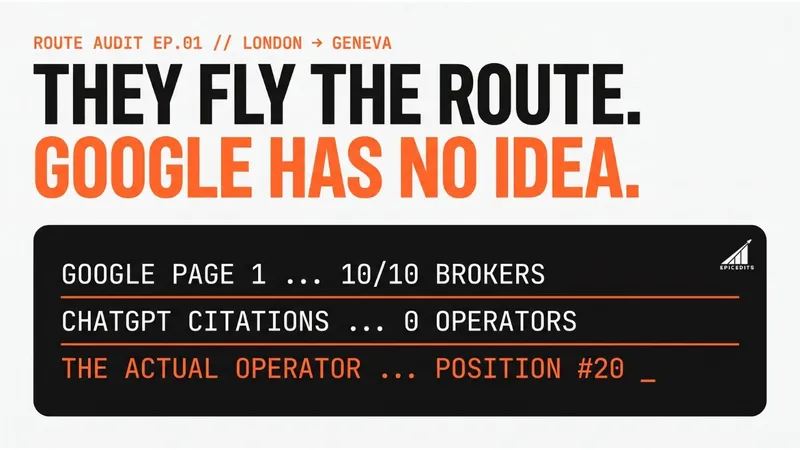
The stakes are not theoretical. In June 2026 we tested one route, London to Geneva, across seven AI platforms. Not one AOC-holding operator made the top ten. Every name was a broker or a marketplace. LunaJets, a broker, scored 70 out of 100 for AI brand visibility. The operators who actually fly the route were invisible. The full method is in podcast episode 2.
AI SEO is not a separate discipline. It sits on top of the same foundations as traditional SEO: fast pages, clear structure, and real authority. What it adds is a layer of machine-readability. Entity optimisation. Structured data. Answer-ready content. Citation tracking. This guide walks through each one.
AI citation is one layer of a complete strategy. Our specialist aviation SEO programme covers route pages, authority building, and technical foundations alongside AI optimisation. For the AI layer specifically, see our AI SEO for private aviation service page, or the wider discipline of generative engine optimisation.
| Component | What it involves | Why it matters |
|---|---|---|
| Entity optimisation | Making your company, fleet, and routes recognisable to AI as distinct entities | AI cites entities it can identify, not anonymous pages |
| Structured data | Flight, Service, LocalBusiness, FAQPage schema on every page | Schema lets AI extract facts accurately without guessing |
| Answer-ready content | Direct answers to common buyer questions in the first 200 words | AI extracts the first clear answer it finds to surface in responses |
| Content architecture | Inverted pyramid format: key facts before supporting detail | AI tools read top-down and cite what they encounter first |
| AI citation monitoring | Tracking how AI tools represent your brand in responses | Reveals gaps between your real authority and your AI visibility |
What Makes Aviation Different
- • Commercial queries show fewer AI summaries, but the ones that appear win the enquiry
- • The shortlist is short: AI names two or three companies, not ten
- • Safety-focused searches prioritise authoritative sources like ARGUS and Wyvern
- • Route-specific queries need complete information: airports, flight time, aircraft
- • Pricing searches still require human interaction, so citation drives the enquiry
How Does Each AI Engine Differ?
The three engines that matter for charter operators do not behave the same way. We measured this directly. In our London to Geneva route test, we compared each engine's recommendations against Google's top ten organic results for the same query.
| AI engine | Overlap with Google top ten | What that tells you |
|---|---|---|
| Perplexity | 89% | Rank well in Google and Perplexity mostly follows |
| ChatGPT | 40% | Needs citations and entity signals beyond rankings |
| Google AI Mode | 33% | Rewards direct answers and schema over raw rank |
Source: EpicEdits London to Geneva AI Route Test, June 2026. One route, seven AI platforms, brand visibility scored out of 100. Full method in episode 2 of our podcast.
The practical order follows from those numbers. Google rankings come first, because they carry you most of the way into Perplexity. Then structured data and direct answers, because Google AI Mode reads those more than it reads rank. Then citations on trusted aviation sources, because ChatGPT leans on what other sites say about you. That last part is the core of our Citation Gap Method.
Google AI Overviews and AI Mode
Google's AI layer integrates with existing search infrastructure, so traditional SEO still matters. But it selects differently:
- • Comprehensive schema markup for aviation data
- • Clear factual statements about aircraft capabilities
- • Geographic specificity for routes and service areas
- • A direct answer in the first 200 words of each page
- • Authority signals through certifications like ARGUS and Wyvern
Perplexity
Perplexity runs real-time search and shows its sources. It rewards:
- • Educational content explaining aviation concepts plainly
- • Current information with recent publication dates
- • Clear source attribution and named data
- • Technical accuracy in terminology
- • Strong Google rankings, which feed its retrieval directly
ChatGPT Search
ChatGPT is the hardest engine to enter through rankings alone. It rewards:
- • Mentions and citations on trusted third-party aviation sources
- • A clear, consistent brand entity across the web
- • Question-and-answer content structure
- • Access for GPTBot in your robots.txt
- • Reviews on platforms AI pulls into its answers
The Implementation Checklist
Work through these four layers in order. Each one builds on the last. Skipping ahead wastes effort, because AI cannot cite content its crawlers cannot reach, and it cannot extract facts from pages without structure.
1. Entity: Make Your Brand Recognisable
AI engines cite entities, not pages. An entity is a thing the model can identify: your company, your fleet, your routes, your people. If your brand appears under three different names across your site, your Google Business Profile, and the directories, AI treats them as three weak entities instead of one strong one.
Fix the basics first. One exact company name everywhere. One address format. One description of what you do, repeated consistently: who you are, what you fly, where you fly from. Add Organization schema with your legal name, founding date, and certifications. Link your profiles together with sameAs markup so the engines know they all describe the same company.
Then extend the entity to your fleet. Each aircraft type gets its own machine-readable page: seats, range, luggage capacity, typical routes. Fleet specs locked inside a PDF brochure are invisible to every AI crawler.
2. Schema: Give AI Facts It Can Extract
Content AI Loves
- ✓ Clear topic headings
- ✓ Factual statements about aircraft
- ✓ Specific route information
- ✓ Safety credentials displayed
- ✓ Transparent pricing structures
Schema Implementation
Use Schema.org markup for better AI understanding:
- ✓ Flight schema for routes
- ✓ LocalBusiness for FBOs
- ✓ Service schema for offerings
- ✓ Review schema for trust
- ✓ Organization for credentials
Validate every schema block before you publish. Invalid markup is worse than none, because it stops the engines from trusting the rest of your data. Google's structured data documentation and Rich Results Test are the reference tools.
While you are in the technical layer, open your robots.txt. Allow GPTBot for ChatGPT, ClaudeBot for Claude, PerplexityBot for Perplexity, and Google-Extended for Google AI. It takes minutes, and most operators have not done it. Blocked crawlers mean zero visibility, no matter how good the content is. Watch for the other pitfalls too: content locked behind JavaScript or login walls, slow pages that crawlers abandon, duplicate copy across aircraft pages, and missing alt text on aircraft images.
3. Answer-Ready Content: Write for Extraction
AI tools cite content they can extract fast. Format matters as much as facts. Start each key page with a short summary box: a direct answer in 40 to 60 words. Then use headings written the way buyers ask questions. This makes it easy for AI to pull a clean answer and name you as the source.
Use the inverted pyramid. Essential details first, supporting information second, context last. For a London to Paris route page, the first 200 words carry the departure airports, flight duration, aircraft options, pricing range, and safety credentials. Everything else follows.
Formats AI Extracts Most
- • Summary boxes: a 40 to 60 word answer at the top of the page
- • Question headings: H2s like "How much does it cost?"
- • Comparison tables: aircraft specs, range, and passenger counts side by side
- • Step-by-step guides: booking, customs, and safety steps in order
- • Definition blocks: plain answers for aviation terms and rules
- • FAQ sections: real client questions with clear, factual answers
Get Your FAQ Section Right
A strong FAQ section is the easiest AI win. Aim for 15 to 25 questions on each pillar page. Keep each answer between 60 and 120 words. That is long enough to help and short enough to cite.
Cover the questions buyers actually ask. Cost, booking process, safety, timing, and how you compare. Answer with facts and numbers, not marketing lines. One clear answer beats five shallow ones. Mark the whole section up with FAQPage schema so the engines can lift question and answer pairs directly.
4. Route Pages: Own the Queries That Convert
Every route you fly has a search term attached to it. "Private jet London to Geneva." "Charter flight London to Ibiza." Real buyers, PAs, and family offices type these into Google and ask them of AI tools every day. Whoever owns the answer collects the enquiry. On most major routes today, that is a broker, not the operator who flies the aircraft.
A route page is not a sentence on your homepage saying you fly to Nice. It is a full page for one city pair: both airports and why, flight time by aircraft type, aircraft options with seats and luggage, indicative pricing, and slot or customs notes the buyer does not know to ask about. Structure it with the summary box, question headings, and Flight schema described above.
Build route pages for your busiest city pairs first. They are the pages AI cites when a buyer asks about a specific journey, and they are the pages that convert, because the buyer who searches a route is ready to fly it.
How Do You Measure AI Search Performance?
Traditional SEO metrics do not capture AI search performance. Rankings still matter as an input, but the output you care about is different: does AI name you, and does it get the facts right?
Key AI Search Metrics
- 1.Citation frequency - How often your content appears in AI responses
- 2.Source attribution - When AI platforms credit your content
- 3.Response accuracy - Whether AI presents your info correctly
- 4.AI-referred traffic - Visitors from AI platform citations
- 5.Conversion quality - How AI traffic converts vs organic
Start simple. Write down the ten questions your buyers actually ask, including your top three routes. Ask them of ChatGPT, Perplexity, and Google AI Mode once a month. Record who gets named and in what order. That one spreadsheet tells you more than most dashboards. For a step-by-step tracking workflow, see our guide on how to track your Perplexity mentions.
If you want the measurement done for you, with scores per engine and per route, that is exactly what the AI Visibility Diagnostic produces.
Frequently Asked Questions
AI search platforms like Google AI Mode, Perplexity, and ChatGPT change how wealthy clients find private jet services. The buyer asks one question and gets a shortlist of two or three names, not ten blue links. If AI cannot read and cite your site, your competitors take those slots. In our own London to Geneva route test, zero AOC operators made the AI top ten. Every name was a broker or marketplace.
AI platforms prefer clear topic headings, factual statements about aircraft, specific route information, safety credentials, and transparent pricing structures. Use an inverted pyramid approach: put essential details first in the first 200 words: departure airports, flight duration, aircraft options, pricing range, and safety credentials.
Private jet companies should implement Flight schema for routes, LocalBusiness schema for FBOs, Service schema for offerings, Review schema for trust, and Organization schema for credentials. Schema markup helps AI tools understand and accurately cite your aviation content.
Track citation frequency in AI responses, source attribution, response accuracy, AI-referred traffic, and conversion quality. Traditional ranking positions become less relevant when content gets integrated into AI answers rather than displayed as a search result. Start by asking each AI platform your buyers' questions and recording who gets named.
Both, but in order. In our London to Geneva test, Perplexity overlapped with Google's top ten at 89 percent. So Google rankings carry you a long way into Perplexity. ChatGPT overlapped at only 40 percent and Google AI Mode at 33 percent. Those two need citations, structured data, and answer-ready content on top of rankings.
Expect three to six months for measurable movement. Schema fixes and robots.txt changes take effect within weeks, because AI crawlers revisit often. Entity building and citations take longer, because AI models lean on sources that already trust you. The order matters: technical access first, then structured data, then content, then citations.
No. They share the same foundations: fast pages, clear structure, honest content, and authority. AI SEO adds a layer on top: entity optimisation, extra schema types, answer-ready formatting, and AI citation tracking. Running them as one programme costs less and works better, because Google rankings feed Perplexity visibility directly.
Further Reading
Related guides on AI search and private aviation SEO:
- • Private Jet AI Visibility Guide
- • How to Get Cited by ChatGPT
- • Best Private Jet SEO Strategies
- • AI SEO for private aviation
- • The Citation Gap Method: our framework for closing the gap between real-world authority and AI citation visibility
AI Visibility Diagnostic
Get Your Charter Brand Cited by AI
We build AI SEO programmes specifically for private aviation. Book an AI Visibility Diagnostic to see your current AI visibility score.
Sources
- EpicEdits London to Geneva AI Route Test, June 2026 - one route, seven AI platforms; full method in podcast episode 2
- Google Search Central - structured data and AI search documentation
- Schema.org - vocabulary for Flight, Service, LocalBusiness, FAQPage, and Organization markup