Key takeaways
- •Charter buyers now start with an AI answer, not a referral. The AI names a few operators and ignores the rest.
- •A charter enquiry is a perishable lead. Half a day late and it is booked somewhere else.
- •Aviation has almost no citation infrastructure yet. That gap is the opening for operators who move first.
- •Brokers and aggregators collect the mentions and reviews. Build your own and you take that visibility back.
Search itself is changing. Organic clicks are falling as AI answers take over the results page. This post is the full picture for one industry: private aviation.
Here I want to talk to charter operators and brokers directly. The shift to generative engine optimisation hits aviation harder, and sooner, than most other fields. Here is why, and what to do about it.
Why aviation operators cannot afford to wait
2025 was the busiest year on record for business aviation, with around 3.9 million business jet departures worldwide.
The demand is there. The way buyers find you has changed.
For charter companies and brokers, the next client is now far more likely to start with a search than with a referral. Those flyers comparison-shop. They read safety ratings. They research operators the way they would research any big purchase. This is the heart of SEO for private jet charter companies.
And a charter enquiry is one of the most perishable leads in any industry. A trip request left for half a day is usually booked elsewhere.
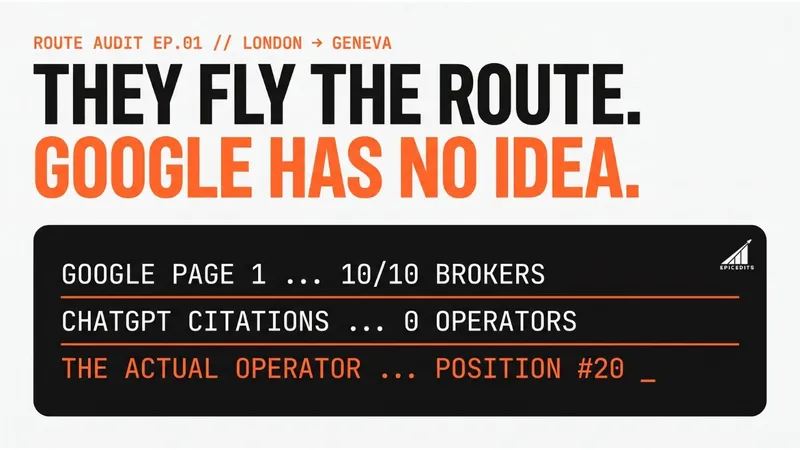
Now picture the new front door. A flyer asks ChatGPT or Perplexity for the best operator on a route. The AI gives back a short list of names. If you are not on that list, you never get the enquiry. You do not even know it happened. It is the same reason AI assistants quietly book your competitors.
If your visibility is still built for traditional search, you are invisible to the buyers who now rely on AI summaries. You are not losing to competitors. You are losing to the interface.
The operators who build citation infrastructure now will own the pipeline for the next decade.
The demand is rising, but the clicks are falling
This is the part most operators have not processed yet. More people are flying, but fewer of them click a link to find you.
Between June 2024 and September 2025, Seer Interactive tracked organic click rates on searches that show an AI Overview. They fell 61%. Even the number one result lost 58% of its clicks. Ranking first is no longer the prize it was.
Pew Research Center saw the same thing in real browsing data. When an AI summary appeared, people clicked a normal result just 8% of the time. Without one, they clicked 15% of the time.
Zero-click searches rose from 56% to 69% in a single year, according to Similarweb. People get their answer and never open a website.
And these answers are now everywhere. AI Overviews appear on nearly half of all searches, up from under a fifth a year earlier, according to Advanced Web Ranking. Semrush found that 88% of the queries that trigger an overview are informational. Those are exactly the questions a flyer asks while choosing an operator.
For charter operators the lesson is simple. Ranking a page is no longer enough. If the AI answers the question for the buyer, your link never gets the click. You have to be inside the answer.
The strategic shift: your KPI is no longer traffic
Your strategy cannot rely on dodging AI Overviews. You need a strategy that reframes the goal as holding share and visibility, not just driving raw traffic.
This is not a temporary adjustment. It is a permanent change in how discovery works.
The winners will not be the brands with the most backlinks or the highest domain authority. They will be the brands embedded in the citation ecosystems the AI leans on. That is the core of private jet AI visibility.
That means building infrastructure that does not exist yet for most charter brands: directory listings, citations, review platforms and the kind of third-party link ecosystem that makes you hard to leave out when an AI builds an answer.
Why does third-party matter so much? Because brands are 6.5 times more likely to be cited in AI answers through third-party content than through their own domain, based on AirOps' study of 21,311 brand mentions for commercial queries. Ahrefs studied 75,000 brands and found branded web mentions were one of the strongest signals for AI visibility. Backlink volume and domain authority barely moved the needle.
Most industries already have this web of mentions. Aviation does not. The big players coast on legacy mentions, while smaller operators have handed their visibility to brokers. That is the gap, and it is exactly where broker dependency quietly costs you margin.
| Signal | Effect on AI visibility | Source |
|---|---|---|
| Branded web mentions | Around 0.66 correlation, one of the strongest signals | Ahrefs (75k brands) |
| Third-party content vs your own domain | 6.5x more likely to be cited via third-party sources | AirOps |
| Being cited inside an AI Overview | 35% more organic clicks, 91% more paid clicks | Seer Interactive |
| Backlink volume and domain rating | Weak correlation with AI visibility | Ahrefs |
How AI decides which operators to name
AI tools do not show ten blue links. They read the web, then name a few operators they trust. Off-site mentions get you into the running. On-page work decides whether the AI can actually read and quote you. So do verification and trust signals. Our AI private jet SEO implementation guide covers the on-page layer in full. Three things push you into the shortlist.
- Direct answers. Put the answer in the first sentence after each heading. State the flight time, the aircraft and the price range. Do not bury it three paragraphs down.
- Named entities. Name your aircraft, your airports and your routes. Say Citation XLS, not midsize jet. Say Farnborough, not the London area. AI needs entities it can cross-reference.
- Clean structured data. Mark up your pages with schema so engines can parse them. Use FAQ schema, Service schema and Organization schema with links to every directory that lists you.
There is a technical trap here too. AI crawlers struggle with pages that hide content behind tabs, accordions or heavy JavaScript. If a buyer cannot see your fleet specs in plain text, neither can the AI. Good private jet technical SEO keeps the content readable.
Where to start: the GEO building blocks
GEO is not a single trick. It is a set of building blocks. Start with two.
Entity-first content
Write about specific things, not vague topics. Name the aircraft, the airports and the routes. Give real operating detail an AI can cite: cabin size, range, runway limits, typical timings. Generic pages get skipped.
Structured data everywhere
Every page needs JSON-LD schema. Service pages need Service schema. Route pages need FAQ schema. Your homepage needs Organization schema with links to every directory that lists you. This is how engines read your site with confidence.
Then build route pages. A route page is the single strongest GEO asset a charter operator has. When a buyer tells an AI they need six seats from London to Nice on Friday, the AI looks for a page that proves you know that route. Name the aircraft that fit. Give the flight time in the first line. Add an aircraft comparison and an FAQ. Keep the page current. That page is far more likely to be quoted than a generic homepage.
What I am seeing right now
I rank number one for private jet SEO. I show up across AI recommendation engines. I did it without clients first, which told me something useful: this is defensible territory. You can see the detail on the private jet SEO page.
The aviation marketing space is wide open. The big players assume legacy mentions will carry them. The smaller operators have given up on independent visibility. Both leave the door open.
I am building the citation ecosystems, the listicles and the review infrastructure that aviation does not have yet. Not because it is glamorous, but because it is necessary.
The operators who recognise this early will stop leaking margin to brokers and platforms. They will own their pipeline. They will control their story. They will be the names the AI reaches for.
The shift from traditional SEO to GEO is not a trend. It is a reorganisation of how discovery works. The operators who adapt now will not just survive. They will own the next decade of visibility.
The data is clear. The opportunity is clear. The only question is whether you move before your competitors do.
Frequently asked questions
GEO, or generative engine optimisation, is the work of getting your charter brand named inside AI answers. Think Google AI Overviews, ChatGPT and Perplexity. Old SEO tried to rank a page. GEO tries to make the AI pick you when it builds a reply for a flyer.
Buyers now ask an AI before they ask a broker. The AI names a few operators and skips the rest. If you are not one of the names, you never get the enquiry. Aviation has almost no citation infrastructure yet, so the first movers win the spot cheaply.
Earn mentions across trusted third-party sites. Get listed in respected aviation directories and review platforms. Add clear statistics and sources to your content, and mark it up with schema so engines can read it. Brand mentions track AI visibility far more strongly than backlinks alone.
SEO leans on your own domain's authority and backlinks. GEO leans on being mentioned all over the web, because brands are 6.5 times more likely to be cited through third-party content than through their own site. SEO helps you rank. GEO helps you get quoted.
It often moves sooner than traditional ranking. Lower-ranked pages can gain the most. In the Princeton GEO study, position-five pages that added citations gained up to 115% more visibility in AI answers. Build the citation infrastructure early and the effect compounds.
Yes. When you rely on brokers and aggregators, they collect the mentions and the reviews, not you. The AI then names them, not you. Building your own directory listings, citations and reviews takes that visibility back and protects your margin.
Sources
- WingX, Busiest year ever for global business aviation
- Ahrefs, Brand mentions beat links for AI visibility (75k brands)
- AirOps, The influence of offsite signals in AI search
- Seer Interactive, AI Overview impact on Google CTR (Sep 2025 update)
- Pew Research Center, Google users click less when an AI summary appears (Jul 2025)
- Similarweb, Zero-click search behaviour report
- Advanced Web Ranking, AI Overviews prevalence tracking
- Semrush, AI Overviews and query intent study
- GEO: Generative Engine Optimization, Princeton, Georgia Tech, Allen Institute (arXiv 2311.09735, KDD 2024)